

‘a timely nod to the original whilst cleverly reflecting the issues and challenges of today’
‘a timely nod to the original whilst cleverly reflecting the issues and challenges of today’
Set appropriately in Goethe’s home city, Alan Barnes’ revival of Willy Decker’s production of Massanet’s Werther successfully balances romantic melancholy and emotional trauma as it focuses on the psychological descent of the title character as he moves between ecstasy and resignation, dream and reality, sensual desire and longing for death, cleverly positioning itself as a timely nod to the original whilst cleverly reflecting the issues and challenges of the modern day.
Based on Goethe’s 18th C epistolary novel, the action unravels across a six-month period between July and December as legal intern Werther (John Osborn) develops an unfulfillable love for Charlotte (Bianca Andrew) who had previously promised her dying mother that she would marry the successful Albert (Sebastian Geyer). With her father, the Bailli (Franz Mayer) trying to teach the younger children and daughter Sophie (Karolina Bengtsson) carols, in spite of pleas from his friends Johann (Pete Thanapat) and Scmidt (Jihun Hong), Charlotte oscillates between reciprocating Werther’s feelings whilst rejecting him time and time again in her own struggle between personal desire and a sense of duty. The question is whether Werther can move beyond his own all consuming feelings to find his own rightful place in the world?
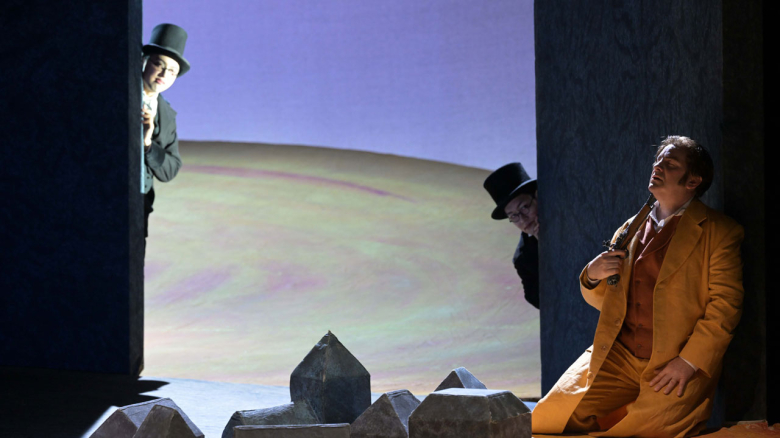
Goethe’s novel sparked a sensation at the time of its publication with its emphasis on self-expression which spread like wildfire without the aid of social media, yet in the modern day, the character appears more narcissistic in his demands to be seen, understood, and loved on his own terms, and it is through this contemporary lens that this production thrives with Wolfgang Gussmann’s minimalist, often surreal set, utilising a sliding screen to separate the current reality from the imagined colours of Werther’s mind. The choice of costume continues this contrast, highlighting the straight-laced conformity of any time and the need to fit in, versus the rebellious nature whose apparent brightness often conceals darker undertones.
Joachim Klein’s lighting design further enhances these extremes, from the budding lightness at the beginning followed by false shoots of recovery, whilst a brooding darkness builds to reflect the changing seasons with clever use of shadow and looming effect hinting at an insight to Werther’s mind.
The cast perform strongly and with good voice including children from Álvaro Corral Matute’s Kinderchor der Oper Frankfurt, led by a faultless Mayer, whilst Rastislav Lalinský as Brühlmann, Jianhua Zhu as Käthchen, and the chorus of Oper Frankfurt portray townsfolk with ease.
Hong and Thanapat impress with their anachronistic portrayal of Tintin’s Thomson and Thompson (Dupond et Dupont) which adds another layer of intrigue to the plot, with Geyer adding weight with brooding tone to his scenes.
Bengtsson, listed as an alternate Sophie, seized her opportunity to shine with some aplomb with a lively vocal and delightful performance that hints at a bright future.
Andrew provides a memorable counterbalance with a warmth and dignity to offset her silent moroseness as she navigates her own course which presents further challenges for her as a woman.
Osborn excels in an outstanding performance, with his vocal capturing both the sweetness of opportunity and the depth of despair as his imagined world slowly but surely closes in on himself.
Felix Bender successfully leads the Frankfurt Opera and Museum Orchestra through the Massenet’s beautiful score, with softer tones of reflection just about balanced with the more intense fortissimo elements which occasionally strayed close to covering the singers, although he just about got away with it.
Review Date: 4th April 2026
Star Rating: FIVE