

‘Many baulk at the length of a Wagnerian opera, but when it is done well it flows quickly and effortlessly; here, Kosky and Pappano combine to deliver a flash of genius’
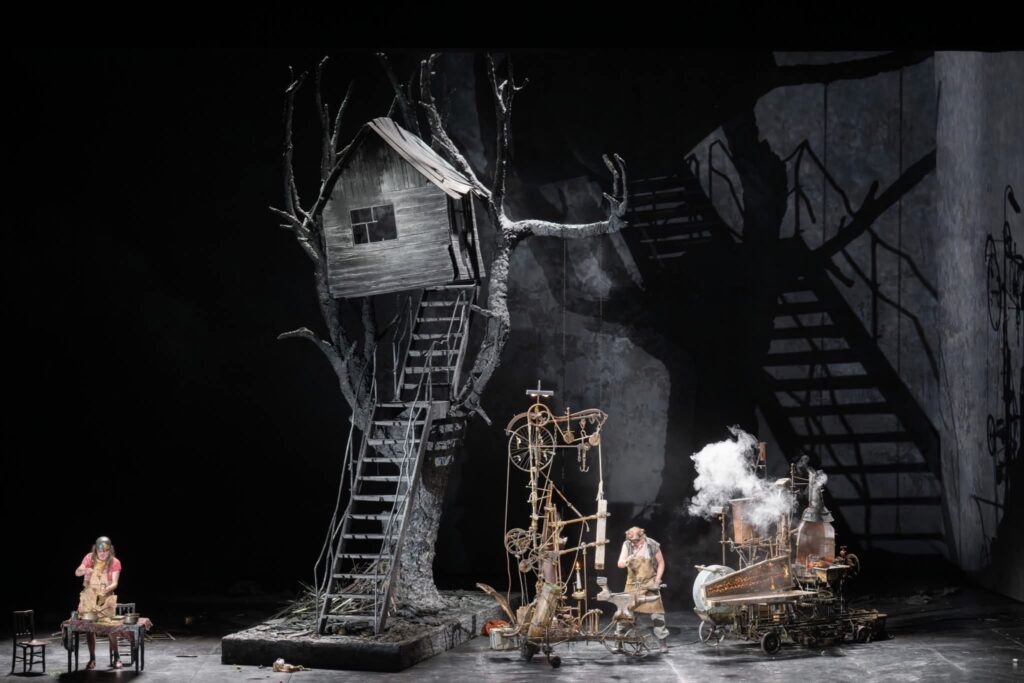
Following 2023’s Das Rheingold and 2025’s Die Walküre, conductor Antonio Pappano and director Barrie Kosky continue the mythical adventure with Siegfried, the third work of Richard Wagner’s four-opera cycle Der Ring des Nibelungen.
In a post-apocalyptic world, a young man, Siegfried (Andreas Schager), unaware of his true family origins, has been raised by a scheming dwarf, Mime (Peter Hoare), but is now ready to embark on an epic journey to take him from darkness to destiny. To get there he will have to navigate a towering Wanderer (Christopher Maltman), Mime’s equally treacherous brother Alberich (Christopher Purves), and a giant, Fafner (Soloman Howard), who has adopted the guise of a dragon to protect stolen Nibelung golden hoard which includes the magical tarnhelm and cursed ring.
But Siegfried has reforged the powerful sword, Nothung, and with an ever-present Mother Earth/Erda (Illona Linthwaite) watching on, mesmerising in her own way, and the insights of a Woodbird (Sarah Dufresne), the hero-in-waiting fearlessly moves on. In a story plagued by right and wrong answers, the real question is whether Siegfried will be brave enough, following a brief re-birthing of Erda (Wiebke Lehmkuhl), to awaken the sleeping Brünnhilde (Elisabet Strid) in this deeply psychological drama.
Many baulk at the length of a Wagnerian opera, but when it is done well it flows effortlessly; here Kosky and Pappano combine to deliver a flash of genius.
Kosky’s vision of the impact of an environmental apocalypse remains although this time with set designer Rufus Didwiszus, they have opted for very different sets for each of the three acts. Mime’s tree house home is firmly embedded in the twisted carcass of the burnt ash tree, with his impressively constructed forge reminiscent of Heath Robinson complete with sparks flying. Fafber’s lair in contrast was snowbound whilst Brünnhilde’s rock haven was a refreshingly Spring-like meadow, with impressive lighting and special effects from Alessandro Carletti.
The stagings are matched by Victoria Behr’s costume design, with the opening Act reminiscent of steampunk with the Wanderer’s outfit cleverly hinting at his decline. Fafner’s outfit was particularly impressive as he has been subsumed by the cursed gold he is guarding, whilst the final act’s appearance of Erda from the voluminous skirts of her older self was inspired.
In the pit, maestro Pappano’s strong connection and understanding with Kosky ensures a revelatory sound from the Orchestra of the Royal Opera House, drawing out the unspoken tensions and ethereal mysticism of this absorbing and dynamic score in spite of the challenges it presents.
It is effectively an opera of two distinct parts – Act III was completed some twelve years after the opening two acts and is vocally very different – and is also the most conversational of the cycle which puts further demands on the singers. Here they are uniformly strong, having been handpicked for their acting prowess as much as their vocal ability, which complements the interpretation and ensures dramatic tension is attained and maintained throughout, none more so than when differing worlds collide, with all the characters clearly defined in terms of easily recognisable qualities, both good and bad.
Act I is very much about Mime with Hoare superbly capturing the nefarious ways and loathing whilst evoking a little sympathy, as his trademark rhythm resonates loudly on his tin hat.
Maltman excels as the Wanderer, broken and troubled but still coldly calculating, with a powerful vocal that belies the fact this is only his third season singing Wagner. His scene with Purves’ impressively evil Alberich was reminiscent of Waiting for Godot, with these two tramps sat on a bench squabbling.
Lehmkuhl gave a sonorous voice to Erda in a brief appearance, whilst Howard’s big vocal added the necessary terror as he staggers on stage, weighed down by the weight of the gold and the world he has created for himself. Dufresne offered a delightful vocal for the Woodbird.
Strid delivered a radiant Brünnhilde, capturing the joy of her awakening amidst the dawning realisation and fear at the loss of her immortal powers with a refreshing soprano thankfully far removed from the stereotypical horned helmet and stretched voice.
The standout, if there has to be one, is Schager who on his Royal Opera House debut stars as the titular hero displaying the necessary vocal stamina and acting ability the role demands and few are able to deliver, very much a force of optimism as he delivers the near impossible fortissimo whilst careering around the stage, shimmying up and down a ladder, working the anvil: the sparks were certainly flying in his consummate performance.
Review Date: 31st March 2026
Star Rating: FIVE