

‘superbly transforming this mythical tale into one of contemporary relevance’
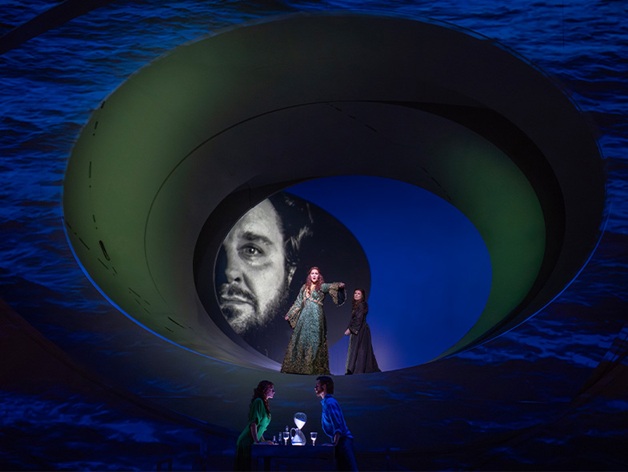
Director Yuval Sharon certainly lives up to his The New York Times billing as ‘the most visionary opera director of his generation’ with his Met-debut staging of Wagner’s breathtaking meditation on love and death, superbly transforming this mythical tale into one of contemporary relevance by positioning the drama as one moment in an endless cycle of life, death, and rebirth.
Isolde (Lise Davidsen) is being escorted by Tristan (Michael Spyres) on his ship back to Cornwall where she is to marry its ruler, and Tristan’s foster father, Marke (Ryan Speedo Green). Humiliated by her captivity, she asks her companion, Brangäne (Ekaterina Gubanova), to prepare poison for her and Tristan to drink but Brangäne mixes a love potion instead and as the ships sails into the harbour, Tristan and Isolde declare their love for each other.
Meeting in secret, the lovers are eventually betrayed to Marke who is devastated by Tristan’s disloyalty, and after a struggle with Marke’s men, Tristan is wounded and only saved by the intervention of his aide, Kurwenal (Tomasz Konieczny). With Tristan lying in a delirious coma, Kurwenal sends for Isolde. Will she arrive in time to save Tristan, or is there a different journey for them to follow?
Simply put, this is a tale about falling in love and dying to which Wagner adds layers of emotional and psychological experiences through a cycle of life, death, and re-birth, and it is this aspect that Sharon’s production has leant into with its highly innovative staging and use of Ruth Hogben’s video design and Jason H. Thompson’s projection to embolden these multiple layers and contrasts of day and night; light and dark; life and death, whilst all the while the waves of the ocean crash, resolve, and repeat.
Adopting a cinematic perspective, Es Devlin’s set design is inspired with an elevated and ever-moving on-stage lens onto cylindrical stages providing a close-up view of the protagonists as well as an insight into their point of view as the drama unfolds as well as serving to represent a birthing canal at one extreme and a portal to the afterlife at another, with some considered choreography from Annie-B Parson.
On the stage below, there are doppelgangers of the protagonists at differing stages of the piece – albeit a little confusing in Act III – all centred around a long table which serves many purposes, and this action is often projected above and around the elevated lens so we can compare and contrast what seems to be happening in the now versus the thoughts and feelings of Tristan and Isolde.
There was a clever colour theme throughout that captured mood across the set in John Torres’ lighting design as well as within Clint Ramos’ costumes, with Tristan’s blue outfits reinforcing his connection to the sea whilst Isolde’s greens emphasised her connection to the land, with their colours softening to reflect their growing connection. In contrast, surrounding characters are clothed more darkly to show the colour – the life – has been sucked out of them.
Does it work? Well, much has been made of Sharon’s approach, and he certainly has the purists up in arms, but I like that he dares to be different because this is about more than just this production, it is about the future of opera as a whole and its ongoing engagement with an audience.
In terms of this production, I found it visually engaging, offering impressive clarity to the underlying themes that can often be lost. Some elements worked better than others but that is only a subjective opinion and others will have different views. Overall, I enjoyed the approach, but more importantly I can appreciate all that he is trying to do. There’s been a lot of noise about the introduction of an on-stage birth, yet it seemed the most natural thing to me in the context of this opera and a fitting finale.
The cast perform strongly with impressive vocals and superb acting throughout reflecting the strong chemistry between them and the balance of experience and new faces, with Green’s grittier bass-baritone contrasting with the usual rolling Germanic basses yet his overall portrayal perfectly captured the conflict between anger and sadness, offering the perfect contrast to the lovers.
Gubanova has been performing Brangäne for some twenty years with this accomplished performance affording her the opportunity to continue finding something new within the role. Konieczny bring similar experience and his powerful bass-baritone was well complemented by his superb acting and interplay with the music.
Not only was self-styled ‘BariTenor’ Spyres making his debut as Tristan – a role renowned for its vocal and stamina demands – but he was also singing alongside one of the most titanic voices in opera in Davidsen, yet none of this was to put him off a powerful performance, from singing over the orchestra with Davidsen for three quarters of an hour in Act II, to delivering some elegant bel canto style phrasing that is often desired but rarely delivered with Wagner.
Davidsen has been hyped for many years and there is no question she has the most powerful instrument that is perfectly suited for Wagner. Here she comes truly into her own with a spellbinding performance that matches that power with subtler, softer shades, with her Liebestod an absolute joy in its slower and sensitive delivery. Importantly, she looked like she was really enjoying it.
This was Music Director Yannick Nézet-Séguin’s first time leading Tristan und Isolde at the Met and the Met Orchestra kept a healthy pace with its sumptuous symphonic scale, although the dynamics were perhaps a little too strong at the beginning when even Davidsen was being covered but this was soon tempered and no better reflected than in the gentle, soft accompaniment to her Liebestod at the end.
Review Date: 21st March 2026
Star Rating: FOUR