

‘I can’t help but feel that something got lost in translation between the three directors’
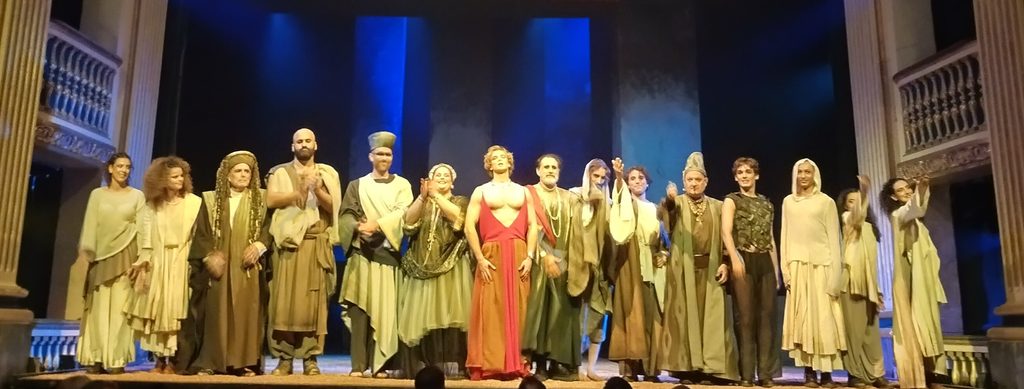
There are numerous challenges with Wilde’s salacious play that was banned for the blasphemous use of biblical characters, with the opera Richard Strauss based on it condemned for the heroine’s notorious striptease in the Dance of the Seven Veils. With most modern productions determined to add to the controversy, director Adrian Buckle throws his hat into the ring by casting a male lead as a Prince now identifying as a Princess.
Bored at a party thrown by her stepfather and uncle Herod (Mikhail Basmadjian), Salomé (Timothy Blore) is haunted by the beautiful voice of Jokanaan (Tarik Badwan), who has been imprisoned in the palace. When he is brought to her by a guard, Naaman (Karl Schembri), Salomé tries to kiss him, but Jokanaan is repelled by Salomé’s physicality. Angered by his rejection and unable to break free of his spiritual hold over her, Salomé bides her time until she can finally touch his lips. Much to the amusement of her mother, Herodias (Magda van Kuilenburg), and the consternation of her Page (Joel Parmis).
Running unbroken for one hour and forty minutes, there needs to be an increasing tension which contrasts both human frailty and the destructive nature of jealousy with the spiritual purity on display, but it all gets bogged down in Wilde’s writing with its endless pleading and repetition before finally getting to the two things everyone has come to see: Salomé’s Dance of the Seven Veils and the presentation of Jokanaan’s head.
Opening with some strongly choreographed routines from Movement Director Chakib Zidi, who performs alongside dancers Sarah Vella, Mona Fazaa, Angela Bettoni, and Rebecca Grech, Buckle’s production clearly envisaged drama on a grand scale but Romuald Moretti’s staging is simplistic with Alexandra Idowiak’s period costumes adding little more to the mix.
With the action predominantly static, the production as whole felt laboured, with no real explanation of the presence or psychology of a variety of figures at the court including a Cappadocian (Vixtor De Bono), a Jew (Barry Kolman), a Syrian (Miguel Muscat), and a Nazarene (Francesco Borg), and the wider political theatre at play although it is alluded to.
Music Director Albert Garzia’s original score starts promisingly with strong hints of the Levant but quickly spirals into synthetic techno-pop that is meant to symbolise the decadent excess, decay, and hedonism of the court yet felt more like a barrage: it was certainly a clash of cultures.
Having opted to be wilder than Wilde, Buckle proceeds to do little with his controversial casting; this is not a reflection on Blore who does his best, but his overly muscular chiselled form didn’t really lend itself to an erotic and sensual seduction scene. Rather frustratingly, the original text provides scope to explore gay and trans issues but this production, despite its stated aim, sadly doesn’t take advantage of the opportunity. With much noise made about the international and diverse status of the casting, I can’t help but feel that something got lost in translation between the three directors.
With a history dating back to 1732, Teatru Manoel is one of the finest examples of Baroque architecture and one of the oldest working theatres in Europe and is Malta’s National Theatre. Further details including upcoming productions at https://teatrumanoel.mt/
Oscar Wilde’s Salomé plays at Teatru Manoel on 7th, 8th, and 13th November at 8pm. Further details and booking https://teatrumanoel.mt/event/salome-by-oscar-wilde/
Reviewer: Mark Davoren
Review Date: 6th November 2026
Star Rating: TWO
Salomé by Oscar Wilde — A Total Disappointment
When one goes to the theatre to see Salomé, Oscar Wilde’s 1891 classic, one expects an outstanding production: impeccable acting, beautiful costumes, excellent sound, and a powerful interpretation worthy of such a celebrated work.
What one certainly does not expect is to see Princess Salomé squeezed into the sculpted, muscular body of a man, while the other characters insist on calling him “Princess” every five minutes!
This is a classic, for heaven’s sake!
I saw no exceptional acting, no remarkable dancing, no memorable singing, and absolutely nothing that moved, impressed, or captivated me.
Creative freedom is one thing. But originality alone does not make a production brilliant, nor does it compensate for a lack of artistic impact.
I went to Teatru Manoel expecting to experience the magic of Oscar Wilde’s masterpiece. Instead, I left wondering what on earth I had just watched.