

‘style overtakes substance with at least one idea too many being played out’
Director Sam Yates’ revival of Clifford Odets’ 1937 critique of the American Dream couldn’t have been better timed given the recent US midterm elections which has brought into sharp focus the division between the have’s and the have nots in the land of opportunity.
New York violinist Joe Bonaparte (Josh O’Connor) decides to risk his hands making a quick buck as a prize fighter in his pursuit of a better life, much to the chagrin of his anxious father (Stanley Townsend) and neighbour Mr Carp (Nicholas Woodeson), whilst brother Frank (Richard Fleeshman) is fighting a different kind of battle with the union.
With manager Tom Moody (Daniel Mays) and promoter Roxy Gotlieb (David Ganly) on board, and the support of trainer Tokio (Jason Barnett), Joe is determined in his resolve to be a success, despite the questioning of a journalist, Drake (Oliver Ryan), and an ageing fighter, Pepper White (Patrick Martins).
But as the sensitive and gifted boy hardens up, bout by bout, he is caught between his love for Moody’s girlfriend, Lorna (Hayley Squires), and being spurred on to win at all costs by mobster Eddie Fuseli (Zubin Varla), as the tragedy of his Faustian bargain between his art and brute force finally comes to a head.
Set and costume designer Rosanna Vize’s monochrome staging cleverly captures the downbeat nature of the period and the underlying mood of the drama: there may be shadows aplenty in James Farncombe’s lighting design, but there is nowhere to hide in the cramped spaces of apartments, offices, or locker rooms.
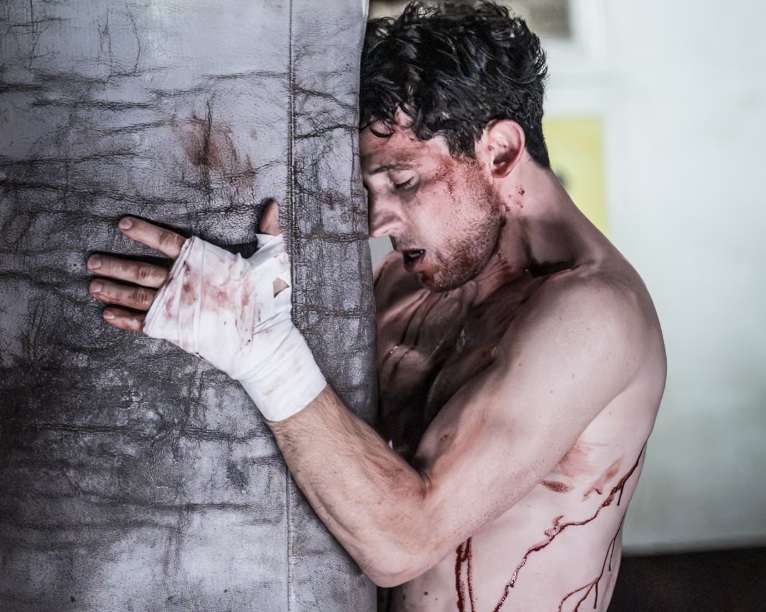
Joe’s movement in and around a punch bag – coordinated by Imogen Knight and Kate Waters – perfectly reflects the turmoil of each bout, although Josh Phelan’s embedded video camera with live projection seemed unnecessary. There is clever use of make-up to reflect the bodily bruising in a bout although this often got left in place despite the action progressing.
In a similar vein, given the absence of rope rings we were presented with strings instead, as a quartet – Roman Lytwyniw (Musical Director/Violin 1); Anna Cooper (Violin 2/Piano); Niki Moosavi (Cello); and Georgia Russell (Viola) – performed arrangements by Isobel Waller-Bridge to embody Joe’s inner trials and tribulations. Whilst an inspired idea that overall worked well, the pulling back of shutters to reveal the musicians playing felt clumsy. I did enjoy the brief choreographed cameo between a violinist and O’Connor that really got to the emotional heart of the piece.
A young Joe (Anton Vehring) appears at various points and whilst an interesting idea, it was at times confusing as scenes and timeframes became blurred. I often say that less is more and I can’t help but feel that style overtakes substance with at least one idea too many being played out, none more so than the addition of a closing scene: there is enough in this play to ‘show’ the drama without needing to ‘tell’ the story any further.
Once strong American accents and mannerisms have calmed down, generally the cast perform well, although I must question why they are miked up. There was also a tendency from Yates to encourage some towards caricature which too often undermined an important piece of theatre.
Much has been made of O’Connor’s return to the stage, and he impresses in a demanding role as he captures not only the physical transformation but also the simmering intensity and restlessness of a flawed character in a compelling performance.
Squires’ Lorna is the opposite side of the same coin, embodying the hardness and edge of a survivor at the last exit to Brooklyn, subtly capturing her emotional connection with Joe and her own fear of it. Whilst well performed, the rendition of Help Me Make It Through The Night, was another example of Yates going a step too far.
In other roles, Mays is excellent as the fast-talking and very believable manager, whilst I enjoyed Barnett’s reliable trainer and Fleeshman’s moral counterpoint.
Reviewer: Mark Davoren
Review Date: 5th November 2026
Star Rating: THREE