

‘This is a play to enjoy and a play to make one think, but I can’t help feeling that there was perhaps too much laughter’
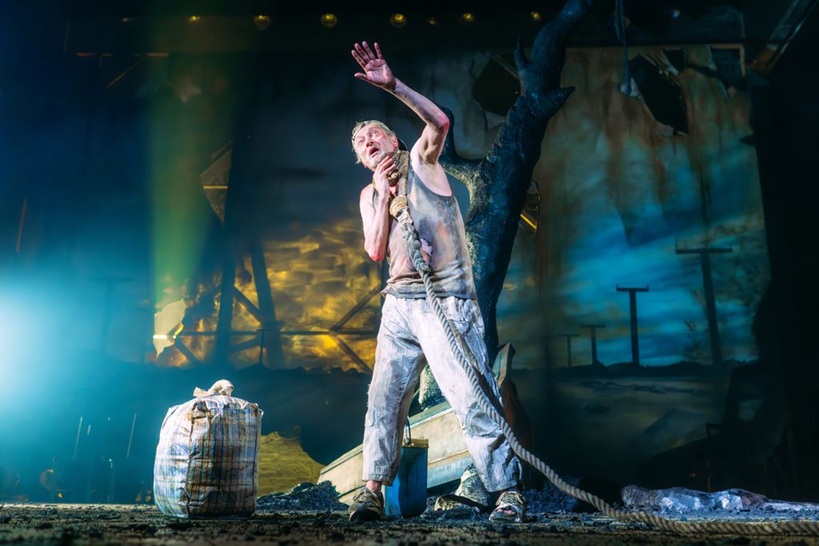
Director Dominic Hill takes a fresh look at Samuel Beckett’s absurdist 1953 tragicomedy about two down at heel men waiting for a mysterious figure to appear, with an engaging interpretation that focuses more on the inherent humour within the play rather than just the disconsolate existentialism with which it is usually associated.
Opening to a dystopian landscape bereft of any positive discernible feature other than a leafless tree growing through the window of a car door, we encounter Estragon/Gogo (Matthew Kelly) and Vladimir/Didi (George Costigan), as they wait for Godot. Whilst their connection to each other is unstated, there is an endearing affection between them that pervades their ongoing conversations about something and nothing, which distracts from the obvious bleakness of their everyday lives.
The appearance of the tyrannical Pozzo (Gbolahan Obisesan) alongside his servant, Lucky (Michael Hodgson), provides a contrasting existence as we witness Pozzo’s brutality and Lucky’s abuse, that begins to make Vladimir and Estragon’s very existence seem almost normal although the appearance of Boy (Daniel Magill) makes it clear that nothing is what it may seem.
The following day offers the green shoots of hope, with Estragon and Vladimir revelling in the comedic sense as the master-slave coupling return to the scene, but the re-appearance of the Boy serves only to reinforce that this is a cycle they are condemned to repeating time and time again. The question is whether that is preferable to other alternatives?
With its origins in the Theatre of the Absurd, a movement that emerged in post-World War II Europe, the original play – En Attendant Godot – was written in French, as Beckett resided in France, and his immediate experiences of the war through his involvement with the French resistance and the unfolding narrative that followed regarding the Holocaust resonate throughout the play: man has free will but the choices are futile in a world devoid of meaning. Beckett’s subsequent English language reworking was voted as the most significant English language play of the 20th century.
The ongoing relevance of the play can be seen from the landscape that sadly surrounds us today whether we look to the Ukraine or the Middle East, where events have exploded more recently in and around Iran, or closer to home where the ongoing consequences of the pandemic and the spiralling cost of living through energy crises have seen people turn more and more to extremism, both politically and socially.
Jean Chan’s set cleverly captures all the angles of this barren new world with the pylons on the backcloth resonating strongly with the religious subtext, whilst his costumes remind us that this is the world of today if we care to look out of the window from our own humdrum existence.
Lizzie Powell’s lighting design was intended to mark the passage of time but didn’t feel that it had translated well to the thrust stage of the Everyman and was on occasion blinding. Similarly, the blocking needs revisiting to take better advantage of the opportunities this venue presents.
Overall, Hill’s production felt less subtle and more obvious in its approach, weighing heavily on the humour and playing for laughs at every opportunity which is a shame because it missed the opportunity to draw attention to the lessons from history that we are destined to repeat if we do not heed them. The human factor at the heart of every tragedy uses humour to self-deprecate or lighten the moment – keep smiling and carry on – but here it felt somewhat over the top.
There are strong performances from the cast with Kelly and Costigan drawing upon an almost sixty-year connection and friendship to combine effortlessly at times, none more so than in the hat swapping exchange. Separately, it felt like Kelly played Kelly just for laughs and whilst sometimes amusing, there needed to be more gruffness and depth to his portrayal. In contrast, Costigan was simply excellent with his mercurial take on affairs and an absolute joy to watch.
I wasn’t convinced with Hill’s interpretation of Pozzo so whilst not a reflection on Obisesan’s obvious quality as an actor, it was difficult to engage with the characterisation, whilst again in contrast, Hodgson was superb in his portrayal of Lucky moving effortlessly between downtrodden pose to an explosive performance when afforded the opportunity to speak.
This is a play to enjoy and a play to make one think, but I can’t help feeling that there was perhaps too much laughter.
Waiting for Godot is a Citizen Theatre, Liverpool Everyman & Playhouse, and Octagon Theatre Bolton production. It performs at Everyman Theatre in Liverpool through to 4th April with further details and booking at https://everymanplayhouse.com/event/waiting-for-godot/
Review Date: 19th March 2026
Star Rating: FOUR