

‘a production that lingers – not because it shouts, but because it speaks with clarity’
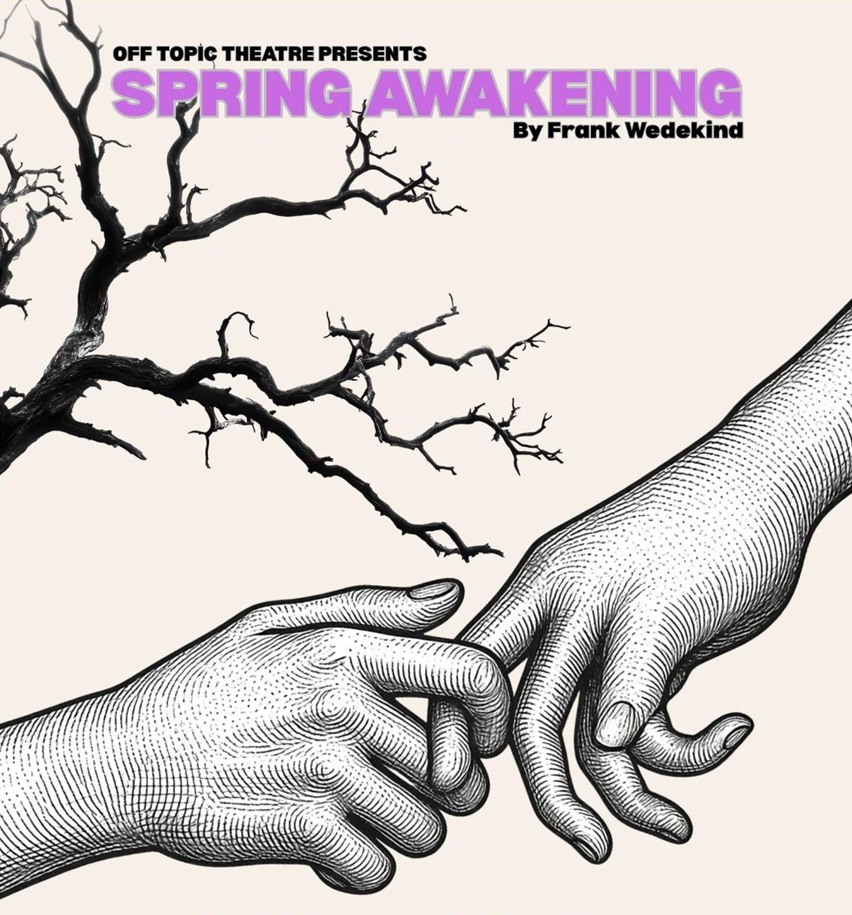
Directed by Clayton Travis along with Assistant Director Lauren Birks, Off Topic Theatre’s production of Spring Awakening at St Mary’s Creative Space offers a sharply focused and quietly devastating interpretation of Frank Wedekind’s once-banned play. Rather than leaning on shock value, the company delivers a measured, intelligent staging that exposes the emotional cost of a society built on silence. The story follows a group of teenagers as they struggle to come to terms with their own bodies, sexual growth and emotions, all played out in an oppressive society.
The direction favours precision over spectacle, allowing the tension between youthful curiosity and rigid authority to build gradually. Scenes unfold with a deliberate calm that makes the play’s eruptions of emotion feel all the more jarring.
The creative team shape the production with a level of detail, sensitivity, and aesthetic coherence that elevates the entire piece. Rosie and Rob Herrisone‑Kelly bring a unified vision that threads through the show’s visual and emotional language and their work has that Off Topic hallmark: bold choices grounded in character truth.
Rosie Herrisone‑Kelly’s costume design deserves its own spotlight. She captures the tension between repression and awakening with clothing that looks period‑appropriate yet psychologically expressive. The palette and silhouettes subtly track each character’s journey from the buttoned‑down rigidity of the adults to the loosened, lived‑in textures that accompany the teenagers’ emotional unraveling. It’s thoughtful, character‑first design that never distracts, only deepens.
Alfie Boynton’s makeup design adds another layer of storytelling, especially in a show where innocence, bruising (emotional and literal), and vulnerability sit side by side. Alfie’s work is understated but incredibly effective: flushed cheeks that betray desire, pallor that hints at fear, and carefully judged distressing that supports the darker turns of the narrative. It’s makeup that respects the realism of the piece while still heightening its theatricality.
Joseph Madders, as Intimacy Coordinator, is a crucial part of why this production feels so safe, grounded, and emotionally honest. Spring Awakening lives or dies on how well a company navigates its most sensitive material, and Joseph’s influence is evident in the clarity, consent‑based structure, and emotional intelligence of every intimate moment. Nothing feels gratuitous; everything feels motivated. The cast’s confidence in these scenes is a testament to his guidance
Helen Gibbons and Edward Ling’s stripped-back staging keeps attention firmly on the actors, whilst lighting shifts from warm domestic tones to stark, unforgiving whites, subtly charting the characters’ descent into confusion and despair, in a production that trusts the audience to engage with the material rather than be guided through it, and with the ensemble delivering performances marked by restraint and clarity.
Wendla Bergmann is played by Xiao Hao Fowler with a luminous sincerity that makes her innocence feel painfully real rather than naïve as she navigates adolescence.
Faye Tierney’s Moritz Stiefel gradual collapse is handled with heartbreaking understatement, capturing the suffocating weight of expectation.
Eli Yim as the rebellious Melchior Gabor brings a restless intelligence to the stage, embodying the play’s critique of knowledge wielded without emotional maturity.
The adult roles – so often played as broad caricature – are instead delivered with a refreshing subtlety that strengthens the production’s emotional impact. Stephen Mackintosh’s Headmaster Sonnenstich is chilling in his composure, embodying institutional cruelty not through bluster but through an icy, bureaucratic detachment that makes his authority feel all the more oppressive. Emily Guilfoyle brings a quiet, aching complexity to Frau Gabor, offering one of the production’s few glimpses of genuine compassion while still revealing the limits of a parent trapped by societal expectation. Maria Sakizli’s Herr Stiefel is sharply drawn, her brisk severity underscoring the pressures that drive Moritz toward collapse. Robbie James Williamson, as Herr Gabor, delivers a performance marked by rigid conviction, capturing the generational certainty that fuels the play’s cycle of silence. Together, these adult portrayals deepen the world of the play, reminding us that repression is not abstract, rather it is enacted, upheld, and inherited.
Supporting characters – Ilse (Ella Clancy), Martha (Ava Cannon), Hänschen (Kit Lefroy), Ernst (Sam Boyer). Georg (Natayla Ricketts) Beth Harvey (Thea/Otto) – are given space to breathe, each contributing a distinct thread to the wider tapestry of repression and resistance.
Off Topic Theatre approaches the play’s most challenging subjects with a welcome steadiness. Sexual repression is presented as a systemic failure rather than a historical curiosity.Academic pressure and mental health are depicted with a contemporary resonance that feels uncomfortably familiar.The portrayal of queer identity is tender and understated, offering rare moments of warmth amid the surrounding bleakness. The production’s refusal to moralise gives the themes greater weight; the audience is left to confront the consequences of silence and shame on their own terms.
A thoughtful, tightly crafted, and quietly powerful revival, by stripping the play back to its emotional essentials, the company reveals just how relevant Wedekind’s work remain. This is a production that lingers – not because it shouts, but because it speaks with clarity.
Review Date: 30th May 2026
Star Rating: FOUR