

‘A well-considered evening pairing artistic forms. . . contrasting the grace of the brushwork with the determined movement of a baton or hand’
In the late 1920s, the young Samuel Beckett travelled to Kassel in Germany to visit his aunt Cissie. There, he fell tragically in love with his first cousin Peggy and, through her art dealer father William ‘Boss’ Sinclair, came face to face with German expressionism which was to prove a profound influence on his work.
The Six Paintings concert explores the interplay between visual art and music, developed by Unreal Cities in consultation with Professor Mark Nixon, the director of the Beckett International Foundation and the editor of Beckett’s German diaries, which have been published for the first time in 2026.
The programme, curated by musical director Nick Roth who also selected the pieces, brought together six of the world’s leading musicians, to respond to six paintings that each play a role in this complex story, alongside Samuel Beckett’s impressions and writings narrated by Adrian Dunbar.
Caspar David Friedrich: Two Men Contemplating the Moon
(Painted 1819-1820, collection of Galerie Neue Meister, Dresden)
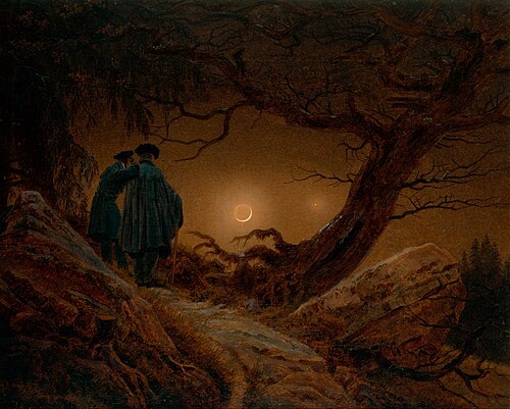
Iarla Ó Lionáird (voice and electronics) presents three original compositions in response to the painting that inspired Waiting for Godot, indeed Beckett’s Theatrical Notebook for the 1975 Schiller production of Godot has the stage direction tell Estragon to ‘contemplate the moon’.
The first piece, I love the Liffey, captured the sense of hope embodied within a familiar place, whilst the second, Claochlú Thuáin – The transformation of Tuán, brought together Celtic mysticism allied with an Irish vocal that gave a real sense of otherworldliness. The third piece, Where rain does not fall, was more melodic in form and explored the sense of love of home and the land: home is where the heart is.
Karl Schmidt-Rottluff: Dr. Rosa Schapire
(Painted 1919, collection of the Tate Gallery, London)
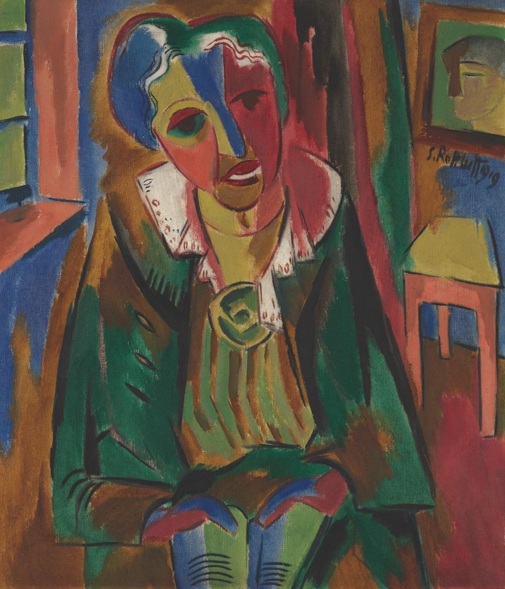
Beckett sees the portrait in the Hamburg apartment of art historian and collector Rosa Schapire, and in his diary entry for 15th November 1936 notes that it is one he has the most difficulty with, ‘a pitiless – pitiful portrait of her it is, expression of consternated sterility on woman & artist, lip lifted in a dribble of bitter cultivation. Lap expressed by shapeless lump of textbook & hands.’
Guitarists Niwei Tsumbu and Benjamin Dwyer performed Nick Roth’s ‘Perilous Bridge’, a composition that was as complex as the painting structure.
Initial plucking of strings morphed into a dissonant disharmony reflecting the rushed brushstrokes with a somewhat jarring reaction as its frenzied energy rose. Further deconstruction followed before segueing to a more melodic beat as the composition – both picture and music – are completed.
Paul Cézanne: Montagne Saint-Victoire au Grand Pin
(Painted 1905-6, collection of the Tate Gallery, London)
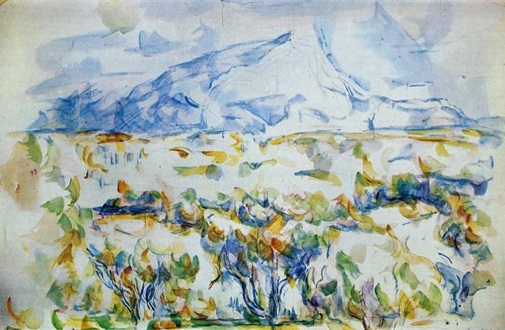
In his letters to Thomas McGreevy in September 1934, Beckett writes that Cézanne seems to have been the first to see landscape & state it as material of a strictly peculiar order, incommensurable with all human expressions whatsoever.
Pianist Mary Dullea performed Beethoven’s Piano Sonata in C minor as a response to the watercolour, as with great dexterity, silences were punctured by some punched notes that emphasised an air of detachment as the crescendo rose.
It was interesting to hear a bolder piece of music applied to a gentle watercolour, which might normally be paired with Satie, Faure, or even Legrand, very much reflecting Beckett’s personal view.
Karl Leyhausen: Portrait of Peggy Sinclair
(Painted 1928; Private Collection, Kassel)
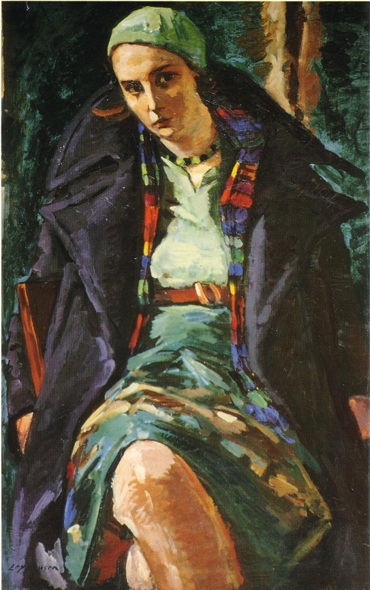
In “Dream of Fair to Middling Women”, written by Beckett in 1932, after his doomed love affair with his first cousin, discovered after his death and published in 1992, he writes:
Whereas it is almost certain that Nemo cannot be made, at least not by us, stand for anything. He simply is not that kind of person. Supposing we told now a little story about China in order to orchestrate what we mean. Yes? Lîng-Liûn then, let us say, went to the confines of the West, to Bamboo Valley, and having cut there a stem between two knots and blown into same was charmed to constate that it gave forth the sound of his own voice when he spoke, as he mostly did, without passion. From this the phoenix male had the kindness to sing six notes and the phoenix female six other notes and Lîng-Liûn the minister cut yet eleven stems to correspond with all that he had heard. Then he remitted the twelve liŭ-liū to his master, the six liŭ male phoenix and the six liū female phoenix: the Yellow Bell, let us say, the Great Liū, the Great Steeple-Iron, the Stifled Bell, the Ancient Purification, the Young Liū, the Beneficient Fecundity, the Bell of the Woods, the Equable Rule, the Southern Liū, the Imperfect, the Echo Bell.
Then it would only be a question of juggling like Confucius on cubes of jade and playing a tune. If all our characters were like that— liŭ-liū-minded—we could write a little book that would be purely melodic, think how nice that would be, linear, a lovely Pythagorean chain-chant solo of cause and effect, a one-figured teleophony that would be a pleasure to hear. (Which is more or less, if we may say so, what one gets from one’s favourite novelist.)
But what can you do with a person like Nemo who will not for any consideration be condensed into a liŭ who is not a note at all but the most regrettable simultaneity of notes.
In response, Cheng Yu performed ‘Flowing Water’ by Zhu Quan on a gujin, a plucked seven-string Chinese musical instrument that dates from ancient times. The subtlety and refinement of the instrument was perfect in reflecting the character and qualities underlining what we know of Sinclair.
Her second piece, ‘Dance of the Yi People’ by Wang Huiran, was performed with a pipa, a traditional plucked Chinese musical instrument, similar to a lute, with a pear-shaped wooden body and a varying number of frets, which was played softly before bursting into life, whilst hinting at the struggles that were to come behind Sinclair’s ever-present gaze.
Oskar Kokoschka: The Bride of the Wind (The Tempest)
(Painted 1913–14; collection of Kunstmuseum Basel)
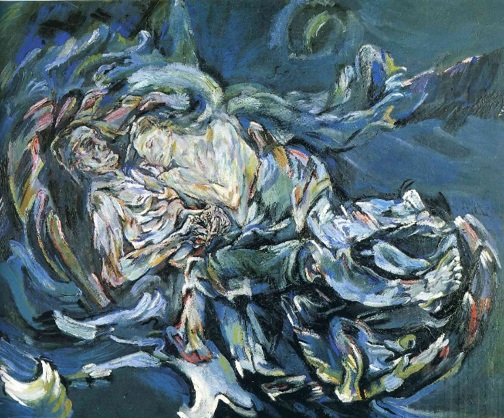
Oskar Kokoschka and Alma Mahler met in Vienna in April 1912, shortly after the death of her husband, composer Gustav Mahler, and they were to have a passionate, turbulent, and obsessive love affair between 1912 and 1914 that heavily influenced Kokoschka and was the inspiration behind The Bride of the Wind.
Beckett’s diary entry for 19th November 1936 notes Kokoschka’s Windsbraut, shipwrecked self-portrait on the bosom of the deep with a woman cuddling up to him, which he would have seen in the cellar of the Hamburger Kunsthalle as it had been removed from display by the Nazis because it was branded degenerate art.
Dullea returned accompanied by mezzo-soprano Michelle O’Rourke to perform Alma Mahler’s Five Lieder from 1910.
It was an inspired choice as the lyrics across the five pieces, sung in original German, caught the emotion, hope, and tension embodied within the picture.
Dullea’s piano work was exquisite whilst O’Rourke’s unaffected expression provided a perfect and moving interpretation.
Karl Ballmer: Kopf in Rot
(Painted c.1930–31; Aargauer Kunsthaus, Aarau)
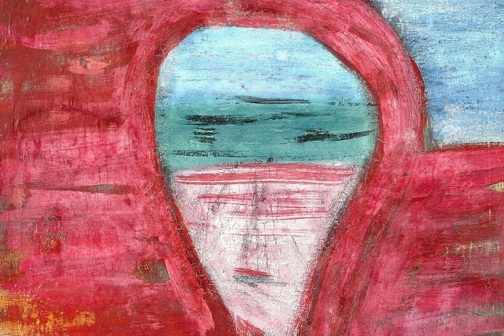
Beckett notes in his diary for 26th November 1936:
Wonderful red Frauenkopf, skull earth sea & sky, I think of Monadologie & my Vulture. Would not occur to me to call this painting abstract. A metaphysical concrete. Fully a posteriori painting. Object not exploited to illustrate an idea, as in say Léger or Baumeister, but primary. The communication exhausted by the optical experience that is its motive & content. Anything further is by the way. Thus Leibniz, monadologie, Vulture, are by the way. Extraordinary stillness. Painter looking at pictures, with no itch for a word. Mild, lost almost to point of apathy & indifference.
Beckett was to remember Ballmer when writing the essay, ‘La peinture des van Velde ou le monde et le pantalon’ after the war.
Dullea rejoined to perform Erika Radermacher’s ‘7 Kleine Klavierstucke’, with an accompanying recital from Dunbar.
The dissonance in the opening echoed apathy and indifference whilst the silences embodied the stillness caught the silences inherent within the painting, whilst the subsequent recital element was more abstract.
In Summary
A well-considered evening pairing artistic forms from literature to lyric, painting to music, and contrasting the grace of the brushwork with the determined movement of a baton or hand, and as such, a fitting finale to the Festival.
I would have liked to have known more about the inspiration for each of Roth’s selections, as art is such a personal thing and we all respond differently, even individually to the same piece accompanied by different emotional circumstance.
More importantly, it perhaps reinforced the brilliance of Beckett, whose work is so precise in its form and structure, that it allows us to layer our emotional experiences across it with such ease and enjoyment.
Beckett: Lieben 2026 Biennale is an international festival celebrating the works of Dublin-born writer Samuel Beckett, in Liverpool from 17th to 20th September. Curated by Adrian Dunbar and Nick Roth of Unreal Cities in collaboration with the Institute of Irish Studies at the University of Liverpool, Culture Ireland, and the Keough-Naughton Institute at the University of Notre Dame, details of the full programme can be found here https://www.liverpool.ac.uk/humanities-and-social-sciences/research/beckett/
Review Date: 20th September 2026
Star Rating: FOUR