

‘offers worthwhile ideas and several excellent performances’
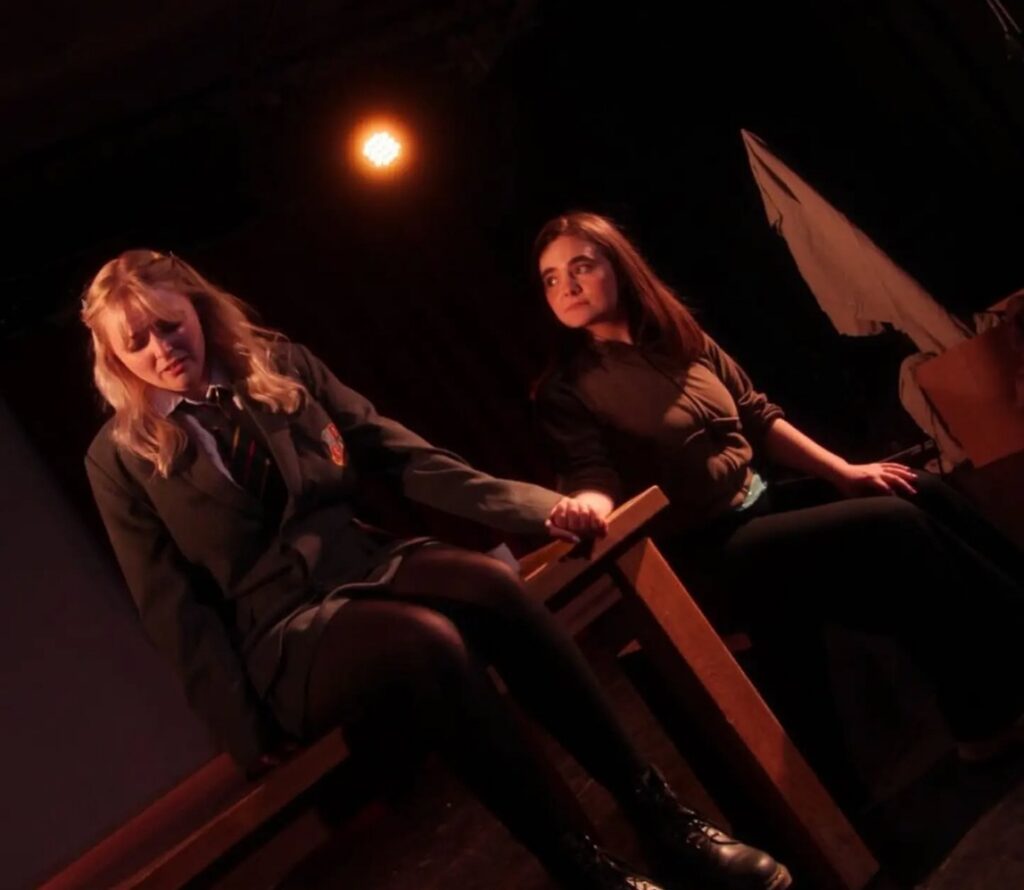
Shakespeare’s Romeo and Juliet is often presented as the ultimate celebration of youthful love, but this adaptation from Karl Falconer and Purple Door Theatre, is more interested in the forces that destroy it than in the romance itself. Split between the perspectives of its two doomed protagonists, it offers moments of genuine emotional power and some impressively delivered verse, yet never quite finds the balance between tragedy, comedy, and social critique that it strives for, and which makes the play so enduring.
The first half is dominated by Romeo’s world, where masculine aggression dictates almost every interaction. Rather than the dreamy romantic hero of popular imagination, Romeo (James Sprague) emerges as a young man trapped within a culture of toxic masculinity. Honour must be defended, insults avenged and vulnerability concealed beneath bravado. The production’s strongest idea is its emphasis on how male violence shapes the narrative long before the lovers’ fate is sealed, Romeo lamenting that ‘Juliet, thy beauty hath made me effeminate’ summing up his world view succinctly.
This is particularly evident in the feud scenes. Tybalt (Rory Duiku) is portrayed with compelling intensity, and his performance stands among the evening’s highlights. Every entrance carries a sense of threat; every line crackles with wounded pride and barely controlled rage. Duiku’s command of Shakespeare’s language ensures that Tybalt never becomes a cartoon villain. Instead, he embodies a social code that values reputation above human life, making his eventual confrontation with Mercutio (Phillips Noel Rose) and Romeo feel tragically inevitable.
Yet while the production identifies toxic masculinity as a central theme, it occasionally labours the point. Certain moments seem determined to explain rather than dramatise the issue, reducing the complexity of Shakespeare’s text. Romeo himself is sympathetically played, but the character’s emotional contradictions are not always fully explored. His impulsiveness and sincerity remain visible, though they are often overshadowed by the broader thematic framework.
The greatest disappointment of the first half lies with Friar Laurence (Karl Falconer). Shakespeare gives the Friar an unusual function within the play, moving between wisdom, comic pragmatism, and eventual culpability. Here, however, much of the humour is flattened. Scenes that should provide relief from the escalating tension pass by with surprising seriousness. The absence of comic energy creates a problem for the production as a whole, since Romeo and Juliet depends upon contrasts between lightness and darkness. Without sufficient laughter, the tragedy risks becoming monotonous rather than devastating.
Ironically, Falconer delivers the text itself exceptionally well. The verse is clear, thoughtful and emotionally grounded. Yet the interpretation seems reluctant to embrace the comic possibilities embedded within the role. As a result, the Friar becomes less a flawed human mediator and more a solemn commentator on events. Given the character’s importance to the plot, this choice has a significant impact on the production’s rhythm.
After the interval, the focus shifts towards Juliet (Tesni Docherty-Bowen) and the pressures exerted upon her by her family. Here the production becomes considerably more compelling. Juliet’s story is framed not simply as youthful rebellion but as the consequence of catastrophic parenting. The Capulets’ failure to listen, understand or empathise becomes the engine of the tragedy. The portrayal of Lady Capulet (Jasmine McIvor) is chilling precisely because it avoids melodrama. Her authority is exercised with absolute certainty; Juliet’s wishes are dismissed before they are even spoken. The production effectively highlights how adults repeatedly fail the young people in their care. While Romeo is constrained by masculine expectations, Juliet is trapped by parental control. Together, these forces leave little room for independent choice.
Juliet herself receives the evening’s finest performance. Whenever Docherty-Bowen speaks Shakespeare’s language directly, the production suddenly comes alive. The emotional journey from innocence to determination is charted with remarkable clarity, and the verse is delivered with both intelligence and feeling. Whether negotiating with the Nurse (Amber King), defying her parents or contemplating the terrifying consequences of the Friar’s plan, she commands attention completely.
Indeed, the strongest performances throughout the evening come when Shakespeare’s text is allowed to shine through. Juliet, Friar Laurence and Tybalt all demonstrate a confident grasp of the language, revealing nuances that contemporary reinterpretation sometimes obscures. In those moments, the production’s themes emerge naturally rather than being imposed from above.
Ultimately, this Romeo and Juliet offers worthwhile ideas and several excellent performances. Its examination of toxic masculinity and parental failure gives the tragedy a clear contemporary relevance. However, the underpowered comic elements – especially surrounding the Friar – prevent the production from achieving the emotional range the play requires. Functional rather than unforgettable, it remains an engaging but uneven interpretation of Shakespeare’s enduring tragedy.
Review Date: 21st May 2026
Star Rating: THREE