

‘MacMillan’s devastating ballet of decadence and decay. . . remains fresh and relevant. . . still offering plenty of room for interpretation’
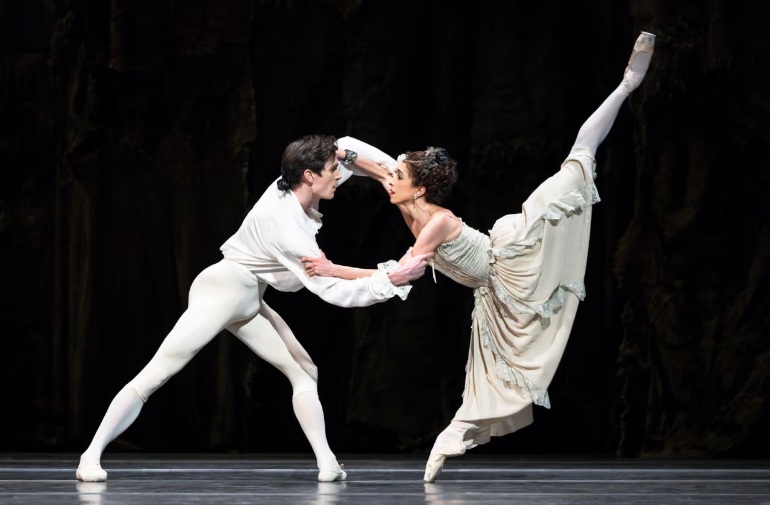
It is over fifty years since Kenneth MacMillan’s devastating ballet of decadence and decay first graced the stage at the Royal Opera House and it remains fresh and relevant to this day, with its standout roles for three main characters still offering plenty of room for interpretation.
Actresses, gentlemen, and the demi-monde gather at the courtyard of an inn near Paris, including a young student, Des Grieux (William Bracewell), the wealthy Monsieur G.M. (Thomas Whitehead), and Lescaut (Joseph Sissens), who is there to meet his sister Manon (Yasmine Naghdi) on her way to enter a convent.
Manon arrives with an old gentleman (James Hay) who is obviously attracted to her but while Lescaut tries to come to an arrangement with him, she meets Des Grieux, and entranced by each other, they fall in love and decide to escape to Paris using money she has stolen. Monsieur G.M. tells Lescaut that he too is interested in Manon and, because of G.M.’s wealth, Lescaut persuades Manon to accept him instead.
Arriving at a party given by Monsieur G.M. at Madame’s (Christina Arestis) hôtel particulier, Manon is clearly torn between the wealth of her companion and her love for Des Grieux, who is there with Lescaut and his mistress (Leticia Dias). De Grieux tries to persuade Manon to leave with him but she encourages him to take more of Monsieur G.M.’s money at cards. When he is caught cheating, they flee to his lodgings but Monsieur G.M. arrives with the police and Manon is arrested as a prostitute. In the ensuing struggle, Lescaut is killed.
Manon has been deported to America and Des Grieux has followed her there pretending to be her husband. When the Gaoler (Bennet Gartside) offers Manon rewards to live with him, Des Grieux kills him. Escaping to the swamplands of Louisiana, Manon renounces all her former ambitions of wealth and splendour for her love of Des Grieux, but what now for love’s young dream…
MacMillan doesn’t flinch from showing us the dark side of the story with designer Nicholas Georgiadis’ backcloth of rags serving as a constant reminder that poverty and wealth sit uneasily side by side. With the sordid nature of the narrative ever present, some of the routines have a hint of the flapper girl about them as they break with the conventions of 18th C France. The authentic costume designs are a blur of oranges and browns with Manon’s innocent white and blue dress in the opening act soon turning to a bejewelled sordid black as temptation overtakes her. With Jacopo Pantini’s lighting dancing cleverly between light, darkness, and shade, there is excellent attention to detail and symbolism, with a decorative bangle effectively a manacle just one such example.
There are several pairings for Manon and Des Grieux across the run of the ballet who all bring their own personal touch. It was easy to see how Naghdi’s petite and pretty Manon entranced all around her, and whilst her apparent initial innocence gives way to an understanding of her sexual power as she is literally tossed around between gentleman and clients, she is anchored by the sweetness and sincerity of that love at first sight moment.
Her various pas de deux with Bracewell are the highlight of the performance, with their natural chemistry helping to capture the tenderness and awkwardness of their first encounter through to a deepening and richer love. Bracewell is strong with a lovely line and throws her around with care. His solos are measured demonstrating great control while her variations allow her to luxuriate in the glory of her own body with her bourrées literally floating her across the stage. Their final dance was heartbreaking as it should be.
Sissens was excellent as the unscrupulous brother and he got the drunken solo and pas de deux in Act II just right, offering the right release from the dramatic tension, whilst Dias impressed as his mistress with some lovely routines.
Whitehead cleverly hinted at the underlying danger of Monsieur G.M. which worked rather well, whilst Arestis was a diligent and organised hostess pairing up a variety of combinations. Gartside was appropriately grubby in his actions and all the more believable because of it.
The score, a selection of music composed by Jules Massenet, was originally compiled by composer Leighton Lucas with the collaboration of Royal Ballet accompanist Hilda Gaunt which interestingly avoided any music from Massenet’s well-known opera score for Manon. Orchestrated by Martin Yates, it provides haunting and heartfelt themes whose intensity and emotion are wonderfully expressed throughout by the Orchestra of the Royal Opera House under the stewardship of maestro Koen Kessels.
Reviewer: Mark Davoren
Review Date: 27th October 2026
Star Rating: FOUR