

‘we were advised that the two leads were ill but would perform nonetheless; thankfully they did because we were served up a treat’
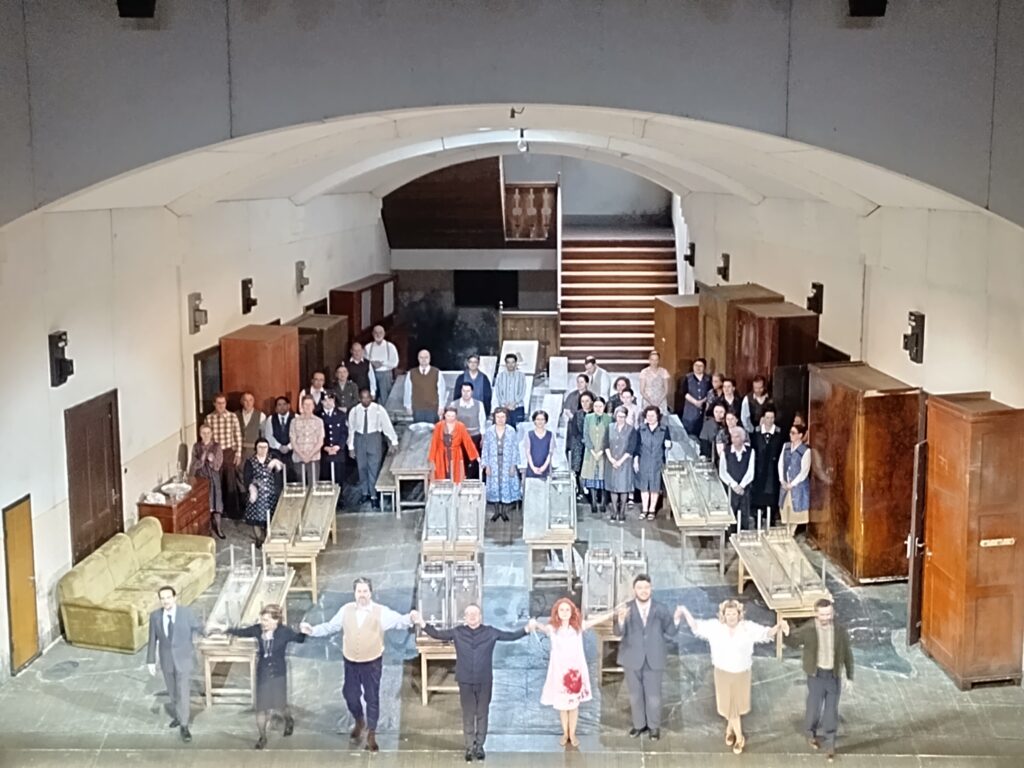
Bellini’s opera is seldom staged so it was with some delight that I had the opportunity to take in Jossi Sheeler and Sergio Morabito’s production at Stuttgart Opera having seen a separate production earlier in the season from the Metropolitan Opera. That co-production with the Royal Ballet and Opera had ridden the storm of the pandemic to get to the stage some five years later, whereas at the outset of tonight’s s performance, we were advised that the two leads were ill but would perform nonetheless; thankfully they did because we were served up a treat.
The orphan Amina (Claudia Muschio) is about to marry Elvino (Charles Sy), a wealthy landowner, with a Notary (Juan Pablo Marin) in attendance. Lisa (Catriona Smith), the innkeeper, is jealous as she also loves Elvino, despite Alessio (Andrew Bogard) being keen on her. A visiting stranger, Count Rodolfo (Goran Jurić), arrives in the village. That night, Amina is discovered asleep in the Count’s room which is explained by her secret condition of somnambulism (sleepwalking). Elvino, consumed by jealousy, breaks off the engagement, believing Amina has been unfaithful. Count Rodolfo tries to explain sleepwalking to the sceptical villagers, and that he had covered her with his sheet to stop her getting cold, but they don’t believe him. The truth is revealed when Amina is finally seen sleepwalking and expressing her grief and despair over losing Elvino. Witnessing this, Elvino finally understands her innocence, asks for her forgiveness, and returns her wedding ring. But is it really a joyful reunion? And who or what is the ghostly apparition (Sandy Liebehenschel) that haunts the final scenes?
There is a historical sentimentality to the original which Wieler and Morabito have wisely chosen to ignore, focusing more on the darker undertones and the treatment of women, with obvious modern parallels, whilst retaining the comic elements to provide some contrast relief, and at the same time making the production all the more believable.
With the more modern focus suggesting Amina’s sleepwalking is a mental health issue, the inclusion of the ghost-like figure from the original, which is often omitted, gave a psychological dimension to Amina’s current travails with the suggestion of an earlier connection to the Count added another subtle twist.
This is further reinforced in Anna Viebrock’s shabby yet plain set design, supplemented by Reinhard Traub’s lighting, which sets the action in a 1950’s-style hostel where who knows what goes on behind closed doors, and whilst there is a perceived disdain and lack of interest in others, it is not enough to stop quick rushes to judgement.
The opening scene was filled with trestle tables and benches that were quickly adapted throughout by the chorus during musical interludes with the set adjustment to take us into the Count’s room during a musical interlude particularly well inspired.
Conductor Vlad Iftinca leads the orchestra through a smooth and balanced performance which musically is a relatively serene and simple accompaniment to a bel canto lyrical style that puts all the expression into the vocal of the singers, and we are not let down by any of them.
Muschio performs with aplomb, with an accomplished technique and range hitting and sustaining the demanding high notes and trills of a challenging coloratura. If she can perform at such a high level when she is unwell, I can only imagine the delights she can muster on a good day.
Sy’s intenseness provides the perfect counterfoil, again with great technique, intonation, and range, and given his reported illness, he tackled the demands of bel canto singing in his stride with a strong performance.
Jurić delivered a commanding vocal whilst maintaining a sense of detachment from the others to delineate his higher social standing although I enjoyed his hidden peeks out through the wardrobe door.
Smith held her own with her blousy portrayal with strong acting – I enjoyed her comic urgency as the bride-in-waiting – and a strong vocal throughout.
Alessio can be easily overlooked so it was a pleasure to see Bogard breathing real life into him with an impressive layered performance that really brought the character to life, whilst Schneiderman served up an assured and determined Teresa, looking out for Amina – and her own interests perhaps – every step of the way.
An approximately 40-strong chorus from Staatsopenchor Stuttgart was the icing on the cake, with superb individual character portrayals whilst combining to deliver an impressive vocal depth that resonated wonderfully with the Staatsorchester Stuttgart throughout.
Review Date: 9th April 2026
Star Rating: FIVE