

‘There is an important and powerful story to be told here . . . but it needs to be better written if we are not to forget the past’
The underlying theme to this play from writer Catherine Harrison – who also uses the pseudonym Charlotte Pickering – is an important one, not least in the light of George Santayana’s famous observation that ‘those who cannot remember the past are condemned to repeat it’, so it is unfortunate that the overall production came up short in terms of presentation and accuracy.
Under the direction of Jed Birch and Executive Producer Rüdiger Schack, the play commences in 1977 with Leonore Siegele-Wenschkewitz (Georgia Laity), a pioneering researcher on anti-Judaism in Christian theology, keen to explore the role of Gerhard Kittel (John Henry), a predecessor at the University of Tübingen, whose research on ‘The Jewish Question’ informed Hitler’s Final Solution.
Through a series of flashbacks spanning from 1907 to 1948, we are presented with Kittel’s encounters with family, friends, and colleagues, although more intriguingly and regularly with a Herr Herold (Kyle Brookes). With supporting characters drawn from an ensemble (Franklyn Jacks; Omar Hussain; Paul Philip Ryan; Tesni Docherty-Bowen; Tom Finney; Sophia Lennon; Roger Conneff; Bethany Wedgewood; Kyle Jensen; Mayuri Kitukale; Pamela Devereux; Scott Murphy; and Charles Yakou), we observe Kittel’s shift from renowned theologian to contributory architect of the Holocaust.
Writers are always told to ‘show don’t tell’ but the challenge with this production was its overall lack of depth. Whilst I don’t mind the less is more approach to staging, the action here was relatively static with an over-reliance on back screen projection to inform us where we were and when in time – that the performance should in fact be showing us – and which in some instances was historically inaccurate.
Characterisation felt too simplistic and one-dimensional with little to no depth or development as we leapfrogged through forty years with inconsistent use of accents and no one appearing to age. The language was forced and unrealistic – including being bombarded with lengthy diatribes about theology – and unrepresentative of how people converse in real life.
I lost count of the numerous scenes – and consequently scene changes – but in a two-and-a-half-hour production, including interval, we must have been averaging one every four minutes or so which completely disrupts the flow of the play and any opportunity to segue between scenes: some people chose not to return after the interval.
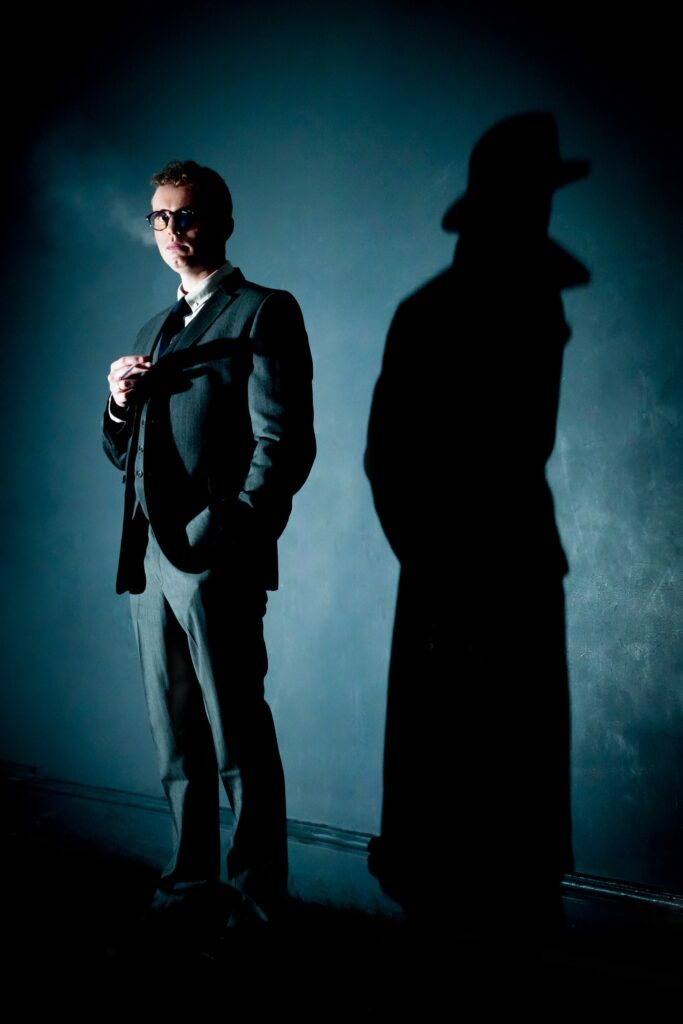
The treatment of Kittel hardly went beyond surface level which gave Henry little to work with; Brookes performed his Mephistopheles-styled role with relish although his heavily accented portrayals of leading Nazi figures were sometimes hard to follow.
The big issue though is the sub-title of the play when there was no obvious pact with the devil. In fact, I found the Kittel-Herold relationship more akin to that of a schizophrenic which could be considered an apologist approach for Kittel’s behaviour, although I am sure that was far from the intention.
The conclusion of the play brings us to 1990 and a dying Siegele-Wenschkewitz – performed in earnest throughout by Laity but whose projection was somewhat over-forceful – which led me to wonder who the play was really meant to be about, and which perhaps goes some way to explaining the overall confusion.
There is an important and powerful story to be told here – particularly given the allusions to current affairs around the world – but it needs to be better written if we are not to forget the past.
Review Date: 23rd January 2026
Star Rating: TWO