

‘it was a brave yet inspired idea to place the Opera Chorus up in the gods and it worked brilliantly’
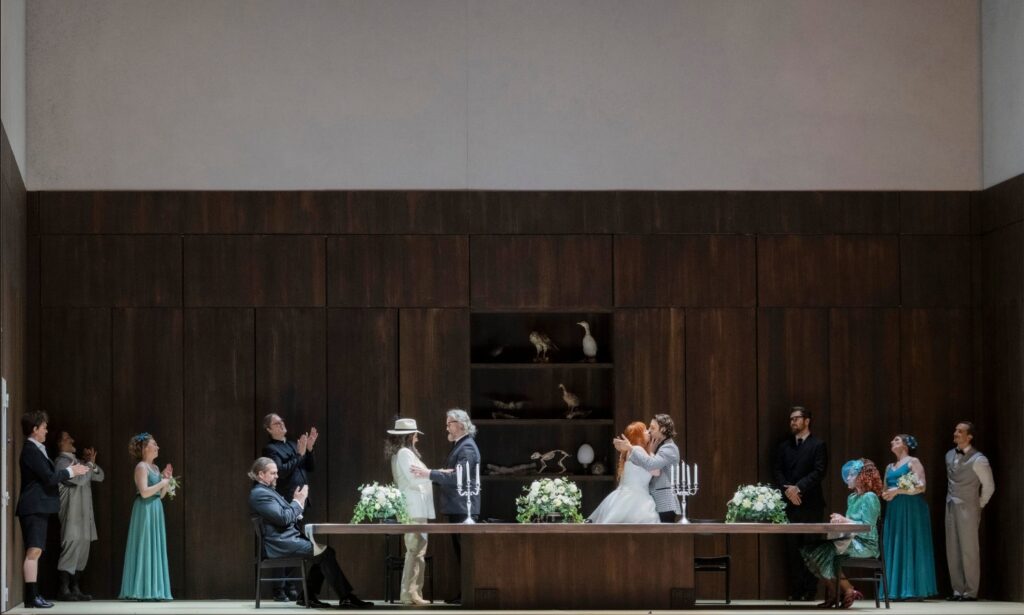
Director Matthew Wild and Set and Costume Designer Katrin Lea Tag combine cleverly to uproot Mozart’s satirical four-act comic opera from its 18th C roots, re-imagining all its mayhem it in a modern-day country home, albeit in a less mischievous but much darker context with an emphasis on its smouldering melancholy.
As the day of Figaro (Tommaso Barea) and Susanna’s (Frøy Hovland Holtbakk) wedding arrives, it becomes clear that Count Almaviva (Aleksander Nohr), is keen to take advantage of the situation and so they conspire with the forsaken Countess (Nardus Williams), to outwit her husband and teach him a lesson in fidelity. Plans however are thrown awry when Bartolo (Jens-Erik Aasbø), seeking revenge against Figaro for thwarting his own earlier plans to marry the countess, tries to force Figaro to marry Marcellina (Lucia Cervoni), a woman old enough to be his mother, much to the amusement of music teacher Basilio (Magnus Staveland). As if things couldn’t get any worse, the amorous teenager Cherubino (Adrian Angelico) pitches up infatuated by anything in a skirt, followed by the young Barbarina (Eline Korbi) who is equally infatuated with him. Throw in drunken gardener Antonio (Pietro Simone) and lawyer Don Curzio (Eirik Grøtvedt), and what follows is a myriad of dark twists and deeper turns as deception counters scheming and misunderstandings foil conspiracies as the plot delightfully unravels.
Wild has chosen to focus on the generational conflicts, contrasting the hope of Susanna and Figaro and the life they have ahead of them, to that of the count and countess whose unbridled dreams have become lost in time. Clemens Walters video design provides the necessary back story although at times it felt we were being told a little too much, and the obvious humour of a child graffitiing seemed at odds with the chosen emphasis of this production on darker undertones.
That is no better evident than the suggestion of a lost child. In other productions, this is hinted at as the cause of heartbreak and the understandable breakdown in the count and countess’ relationship. Here it was front and centre and whilst certainly emotionally poignant, I’m not sure it needed to be laboured so heavily. Throw in the continued suggestion that Susanna is pregnant and it becomes a little too complicated and confusing amidst the tangle of human relationships.
Tag’s staging is exquisite and cleverly done, with the stage split between the countess’ chamber on one side and the count’s quarters on the other, with a somewhat bijou storage room, that Figaro aspires to be his and Susanna’s marital room, cleverly sandwiched in-between, and from where all the deceptions are orchestrated. The stage slides to give emphasis to either of the two main rooms and I particularly enjoyed character’s stepping forward out of the scene and effectively breaking the fourth wall in their delivery of solos. The ‘collapse’ of the count’s quarters for the final act was technically impressive, but it didn’t help convey the action in what is already a challenging and confusing contretemps.
Performed in its original Italian libretto, written by Lorenzo Da Pont, the lyric flows beautifully in conjunction with the live musical accompaniment from the Opera Orchestra who, led by conductor Adam Hickox, play effortlessly and sensitively, moving at pace to the frenetic action on stage, whilst allowing time for the slower sections with the ensembles in particular well balanced. Given the busyness of the stage, it was a brave yet inspired idea to place the Opera Chorus up in the gods and it worked brilliantly.
All the cast performed strongly with good harmonies matched by the wonderful chemistry between the players, with Aasbø and Cervoni combining hilariously to deliver a delightful combination with Grøtvedt’s smart lawyer nicely offset by Simone’s conniving gardener. Staveland’s vocal added to the strong comic routines.
Angelico brought a more considered take on the usually energetic and exuberant Cherubino, whilst Korbi, albeit in a limited role, seized her moment with a fine vocal performance.
Nohr perfectly embodied the Count, desperately seeking to recover the best days that are apparently behind him, with an impressive vocal, whilst Williams caught the heartache of the Countess and wrung every emotion from it – none more so than her Dove sono – in a moving performance.
With less emphasis on the comic, Barea captured the anger and frustration of a young man seemingly not in control of events around him with a powerful vocal in a strong all-round performance, whilst Holtbakk delights throughout in an impressive performance with beautiful phrasing and certainly gave weight to the idea that this was very much her wedding.
Den Norske Opera & Ballett is an impressive venue, both inside and outside, with excellent acoustics and well considered sightlines from the seating. Further information and upcoming productions https://www.operaen.no/
Review Date: 4th September 2026
Star Rating: FOUR