

‘Conteh is a striking piece of theatre that goes beyond the expected sports story’
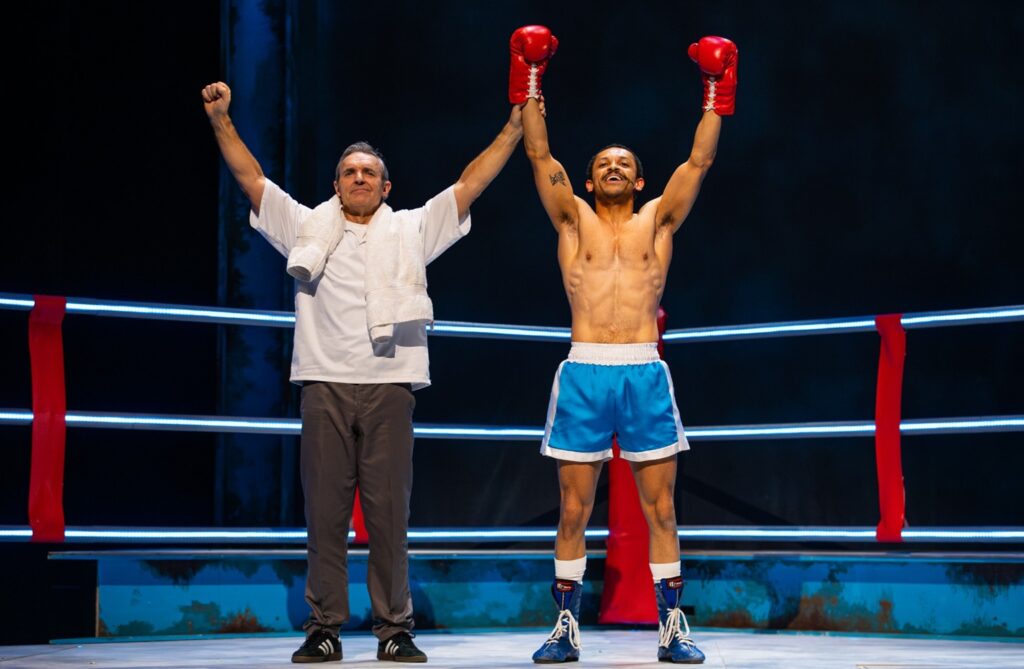
Conteh tells the story of John Conteh, the Liverpool-born boxer who rose from humble beginnings in Kirkby to become one of Britain’s most celebrated fighters. The play charts his journey from ambitious teenager to world light-heavyweight champion, capturing the thrill of his victories alongside the pressures that came with sudden fame. As Conteh’s career peaks, the narrative shifts to explore the personal cost of success—addiction, expectation, and the struggle to hold onto identity when the spotlight never dims.
From the moment Conteh begins, there’s a sense that this is more than a straightforward sports biography. The production immediately establishes its tone—energetic, grounded, and unmistakably rooted in Liverpool’s voice. The audience isn’t just watching a story unfold; they’re pulled into Conteh’s world, where humour, bravado, and vulnerability exist side by side.
Writer Aron Julius takes on the role of John Conteh, delivering a performance that carries the entire production with confidence. His portrayal captures Conteh at multiple stages of his life: the hungry young fighter, the charismatic champion, and the man grappling with the consequences of his own success. Julius avoids turning Conteh into a caricature of sporting greatness. Instead, he allows contradictions to surface—moments of swagger sit alongside flashes of insecurity, making the character feel fully human.
The script gives us key figures who orbit Conteh’s life, each representing different pressures and influences. Amber Blease appears as Conteh’s long suffering wife Veronica, a grounding presence who reflects the emotional toll of Conteh’s lifestyle, while Helen Carter plays the Trainer’s wife and Conteh’s counsellor both characters showing great intuition. Zach Levene plays Conteh’s meddlesome brother who plays an active role in his downfall. He also plays with effect American promoter Don King. Mark Moraghan plays a figure of authority and guidance Trainer, representing both discipline and expectation.
This use of multi-rolling works effectively, allowing the ensemble to create a broader social landscape without losing focus on the central narrative. Each character feels purposeful, contributing to the sense that Conteh’s life is shaped as much by those around him as by his own decisions.
Direction by Mark Womack ensures that the storytelling remains fluid and engaging. Scenes transition seamlessly between different periods of Conteh’s life, often using minimal set changes. This gives the production a cinematic quality, moving quickly from the energy of the boxing ring to quieter, more introspective moments.
The staging of the boxing scenes is particularly effective. Rather than attempting full realism, the production uses lighting, sound, and choreographed movement to evoke the intensity of a fight. The result is less about physical accuracy and more about emotional impact. The audience feels the pressure, the adrenaline, and the stakes without needing to see every punch land.
What stands out most is the play’s emotional honesty. As Conteh’s career progresses, the tone subtly shifts. The early scenes are filled with excitement and humour, reflecting the thrill of a rising star. But as success takes its toll, the atmosphere darkens. The script doesn’t shy away from depicting the consequences of fame—moments of excess, isolation, and self-doubt are given space to breathe.
At the same time, the production never loses its sense of humour. There are sharp, often very local comedic moments that land strongly with the audience, providing relief without undermining the seriousness of the story. This balance is one of the show’s greatest strengths—it feels authentic to the city it represents.
If there’s a criticism, it’s that the narrative occasionally follows a familiar trajectory. The rise, the peak, and the fall are well-worn storytelling beats. However, what lifts Conteh above predictability is its specificity. The cultural detail, the language, and the performances ensure that it never feels generic.
Conteh is a striking piece of theatre that goes beyond the expected sports story. It celebrates achievement while also questioning what that achievement costs. By focusing on the human being behind the title belts, the production offers something deeper than nostalgia or tribute.
At its heart, this is a story about identity—how it’s built, challenged, and sometimes lost. Told with energy, humour, and honesty, Conteh lands as both a personal portrait and a distinctly Liverpool story, one that resonates long after the final scene.
Finally the unexpected appearance of John Conteh brought the audience to its feet amidst rapturous applause.
Tickets available from the Box Office on 0151 709 4321 or Email lauren@royalcourtliverpool.com
BSL performance is on Tuesday 28 April (interpreter Karl Llorca).
Audio Described performance is on Thursday 30 April (describer Anne Hornsby).
Captioning will be available for performances for the final week of the show.
Please contact Box Office for more details.
Review Date: 23rd April 2026
Star Rating: FOUR