

‘paints a rich visual feast that delights all the senses’
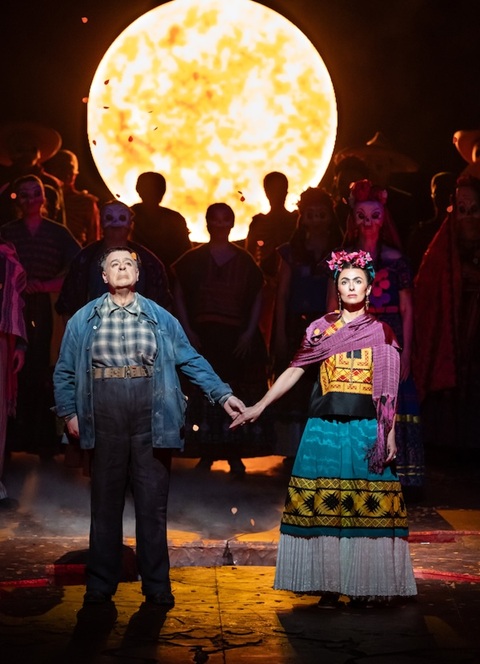
American composer Gabriela Lena Frank’s first opera, a magical-realist portrait of Mexico’s painterly power couple Frida Kahlo and Diego Rivera, with libretto by Pulitzer Prize–winning playwright Nilo Cruz, is wonderfully brought to life by director Deborah Colker who paints a rich visual feast that delights all the senses with this fashioned reversal of the Orpheus-Euridice myth, performed entirely in Spanish.
Opening three years after Kahlo’s (Isabel Leonard) death, Rivera (Carlos Álvarez) arrives in a Mexican village bedecked with marigolds, the vibrant symbol of the Day of the Dead. Physically ailing and lonely without his soulmate, he calls out to Frida; in so doing, he summons Catrina (Gabriella Reyes), the trickster keeper of the dead, in the form of an elderly village woman. Back in Mictlan, the Aztec underworld, Catrina insists that Frida return to the realm of the living and lead her husband on his journey toward death. Frida refuses, declaring that in life she had two major accidents: the impact of a trolley and the blow of meeting Diego Rivera. But she relents when a young actor named Leonardo (Nils Wanderer), dressed in drag as his idol Greta Garbo, encourages Frida to see her temporary earthly return as a chance to reimagine herself in a life without physical pain. With the famously feuding pair briefly reliving their tumultuous love, the opera concludes with Frida and Diego returning to the underworld together, accomplishing the final dream of the title.
Jon Bausor’s set design is impressive as we seamlessly move between village market to Diego’s studio to the underworld, with a centrally placed tree celebrating life and growth whilst its strength lies in the connection of its roots to somewhere mystical. The costumes, by Bausor and Wilberth Gonzalez, provide a further tapestry of colour that bring these worlds to life as they evoke the imagery of both artists.
Colker’s choreographic skills are equally to the fore, balancing the intensity of proceedings with some on-stage humour through hip-hop body-popping skeletons that adds another layer of vibrancy in conjunction with Adam Silverman’s lighting design that draws upon so many hues.
The orchestra were composed under the baton of Conductor Yannick Nézet-Séguin which allowed the vocals to remain at the fore. Musically the piece had perhaps too many elements of dissonance for my liking, and I would have preferred it to flow more, and the repetitiveness of the scores for Frida and Diego felt like it never really took off. In contrast, it was pleasing to see the score honouring its Mexican roots and the incorporation of traditional instruments provided a depth and realism to the celebration of the Day of the Dead.
The four leads have plenty of music to work around, with perhaps the exception of Álvarez as Diego, albeit this was in line with the presentation of his character, but I would have liked to have had a bit more.
Reyes excels as Catrina, really getting under the skin of a character who controls destinies with a beguiling, manipulative vocal performance that had to compete with her own impressive skull make-up and skeleton costume, a transformation that took several hours to achieve prior to performance.
Wanderer’s Leonardo is the key to the complex storyline, and his androgynous performance perfectly reflected an unsettled beauty, matched by an excellent countertenor with an impressive technique that allowed him to switch to tenor and back again at a key moment.
Leonard was superb with a beautiful vocal and expressive range that characterised the complexity of Frida and bringing her emotions to the fore as her journey and its purpose unfolds.
The chorus performed strongly with special mention for Paul Corona, Agel Rail Gomez, and Scott Conner as Villagers, and for Kresley Figueroa, Mary Beth Nelson Zaros, and Cecelia McKinley as Images of Frida.
Review Date: 30th May 2026
Star Rating: FOUR