

‘the power and threat of social media captured in a nutshell, where keeping up with the Joneses has taken on a completely new dimension’
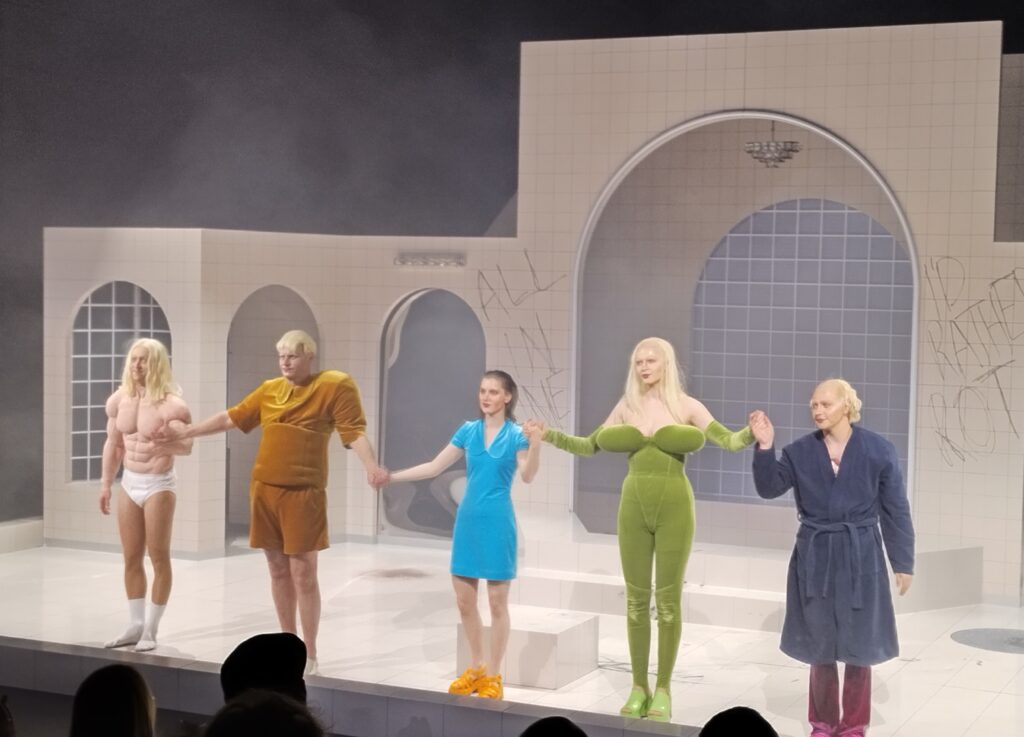
Writer and director Wilke Weermann turns the mirror on the perils of social media and the body shaming challenge of remaining forever young, in this clever modern-day reinterpretation of Oscar Wilde’s The Picture of Dorian Gray, in which beauty, health, and visibility have become the new currency.
Actress Sybil Vane (Teresa Annina Korfmacher) wants it all and she wants it now so is more than happy to have her digital image created to do all the heavy lifting to meet the growing demands of an industry that demands constant perfection and 24/7 availability. Vane by name, vain by nature, Sybil ignores the common sense warning pleas from her sister Jane (Mina Pecik).
In parallel, a somewhat messianic Dorian Gray (Tim Bülow) is promising eternal life without disease or ageing for those seeking perfection through the use of algorithms and AI, with the assistance of Basil (Sebastian Röhrle), and with surely no better example of the merits of such treatment than Henry (Felix Jordan), an all-knowing intellectual who has for some time left the mundane humdrum of his day-to-day existence to an AI whilst he disappears up himself: the lunatics have well and truly taken over the asylum.
As these two worlds collide, Sybil focuses on jettisoning all the things that no longer matter in her pursuit of perfection, allowing her avatar to come more and more to the fore in an idyllic representation of her best self, both physically and mentally. The question is, what happens when the illusion is no longer satisfied with the reality and decides to shed itself of what it considers to be its own waste product?
With a visually arresting staging, Johanna Stenzel’s inspired set design is reminiscent of the Hollywood golden age, but now with an added dystopian dimension that would sit well in a science fiction drama as the experimentation in the pursuit of excellence begins to get literally out of hand. There is good use of colour in Peter Krawczyk’s lighting design which is matched by Teresa Vergho’s costume design which attributes a specific colour to each character, or a very realistic muscle bodysuit in the case of Dorian, as each of them accelerates towards a meeting with their own destiny.
Christian Neuberger’s video design perfectly captures the live steaming of the AI counterparts in an other worldly kind of way, although the coordination of movement between Henry and his alter ego could have been better choreographed. Constantin John provides the soundscapes for a world caving in on itself as all good things come to an unnatural conclusion, with it proving an inspired choice to incorporate a version of The Velvet Underground’s ‘Candy Says’.
Although there is dramaturgy noted from Benjamin Große, it did on occasions become somewhat wordy with lengthy monologues and I can’t help but wonder whether Weermann combining both writing and directing has meant the loss of a critical friend, as running at one hour and forty-five minutes without an interval, it could benefit from some tightening up. It was also surprising, and perhaps somewhat ironic in the context of the piece, for the cast to be miked up in what is a more intimate venue.
The cast perform strongly, balancing humour with realism although I suspect if you showed this to a younger audience they wouldn’t want to believe it: that’s the power and threat of social media captured in a nutshell, where keeping up with the Joneses has taken on a completely new dimension.
Korfmacher captures both the innocence of Sybil and the cunning of her doppelganger whilst Pecik impresses as she reflects the sensibilities of the steadfast sister who ironically becomes the rebel we are all rooting for. Bülow excels as a most measured Dorian, the perfect front for Röhrle’s ‘snake oil’ like Basil, whilst Jordan is perfect as the all too clever for his own good Henry.
Review Date: 10th April 2026
Star Rating: FOUR