

‘a percussive journey through Samuel Beckett’s extraordinary imagination’
As part of Beckett: Lieben 2026 Festival in Liverpool, students on the LIPA BA Acting and BA Dance degree courses performed a percussive journey through Samuel Beckett’s extraordinary imagination: Act Without Words I, Quad, extracts from First Love, That Time, Act Without Words II, Rockaby, and What Where.
Act Without Words I is a short one-act mime play in a stark setting illuminated by dazzling light and with no visible exit, where a single nameless man is violently flung backwards onto the stage every time he tries to leave, and is manipulated by invisible forces represented by sharp, disembodied whistles. His struggles with an array of tantalising objects serves to reinforce human helplessness in an uncaring world, and he only recovers some control through his refusal to engage any further.
Directed by Beth Vyse and Stuart Crowther, there were strong performances from Noah Xavier, Ren Flashner, Tamiya Semaganda, Luke Hudd, and Charlotte Teeples, that captured the futility of choices available to man and his resigned rebellion, with some strong slapstick in the overall circular structure.
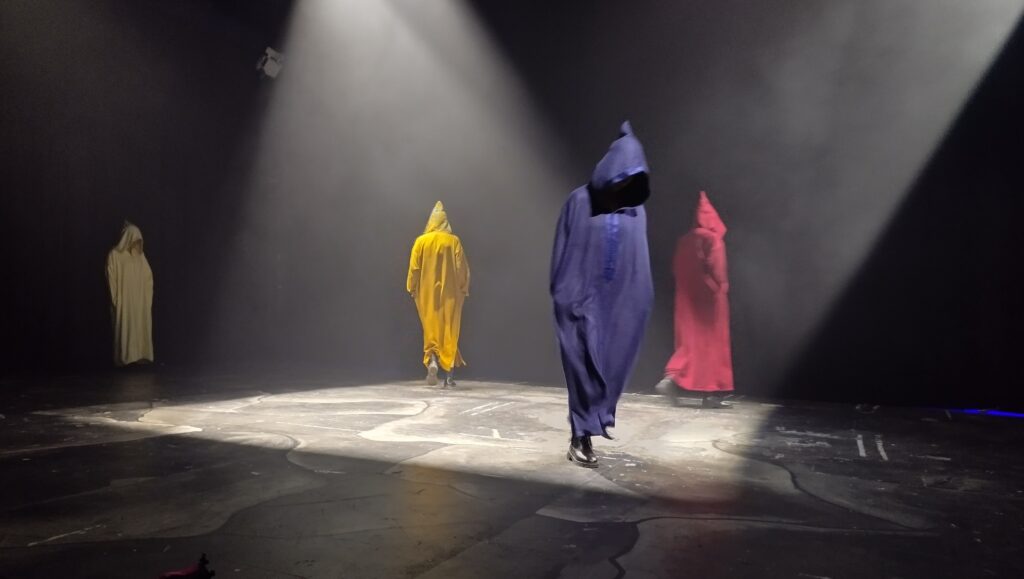
Quad was a minimalist television play, often referred to as a ballet for four people, with no spoken dialogue and relying on intensely choreographed, mathematical movement from four characters, each assigned a distinct colour – white, yellow, blue, and red – and accompanied by a unique percussion leitmotif, as they enter the stage one by one, synchronising their rigid movements along the outer edges and diagonals, building from one person up to four before diminishing back to none.
Directed by Lisi Perry and performed by Elsie Belotti, Ellie Hayton, Ellen Wilson, and Florrie Radley, this was strongly choreographed, capturing a frenzied yet controlled response to the apparent danger at the centre of the square. The outfits impressed a sense of monasticism to proceedings with a suggestion of mental flurry conflicting with a controlled existence.
Two performances on Friday were performed by Connie Butterworth, Elise-Mae Tulloch, Keziah Harfleet, and Lily Juniper.
First Love is a darkly comic, cynical first-person monologue from an eccentric narrator who, following the death of his father, takes refuge on a park bench near a canal, reinforcing his sense of detachment from humanity, but where his solitude is disrupted by a woman named Lulu with whom he becomes infatuated. Remaining detached to her other life, he is ultimately haunted by the consequences of their relationship.
Adapted and directed by Will Hammond using six performers – Akil Abrahams-Moakes, Ren Flashner, Charlotte Teeples, Lilly Schmeda, Maria Lalita Ramjee, and Brodie James – who cleverly untangle the words to express the realities of intimacy with the necessary detachment and cynicism.
That Time presents the Listener, an illuminated long-haired white face of an older man suspended some ten feet above stage level, who remains entirely silent throughout the performance whilst being bombarded by three of his own disembodied internal voices that interweave to reflect different era of his mind: youth, maturity, and old age, who ultimately descend to silence to embody the ultimate deterioration of humanity with the passing of time.
Directed by David Salter and performed by Heartlin Kirkeeide, Reuben M Rogers, Finlay Gilzean, and Rufus Dakin, this was well presented but would benefit from the Listener being positioned closer to the audience and a consistency in accent across the internal voices.
Act Without Words II is a short one-act mime play which presents two large sacks, each containing a very different protagonist, with a ‘goad’ from the wings prodding the characters into action with a repeated cycle that challenges the absurdity and entrapment of routine.
Directed by Beth Vyss and Stuart Crowther and performed by Ren Flashner, Tamiya Semaganda, and Luke Hudd, this was a composed production that may benefit from a mechanical ‘goad’, a slowing of the overall performance, and less white noise.
Rockaby is a one-woman short play which explores the themes of extreme isolation, old age, and the slow surrender to death as a solitary elderly woman dressed in a black gown sits entirely motionless in a rocking chair listening to a pre-recorded tape of her own voice recounting her life’s struggles.
Directed by Emma Bramley and performed by Leia Horler-Clee, this was an evocative and moving interpretation capturing the futility of an isolated existence.
What Where was Beckett’s final play exploring themes of surveillance, serial interrogation, and torture, revolving around a central character named Bam, his disembodied voice, and three other characters, with a character sent offstage to torture another into confessing to a specific what and where as the play cycles through the four seasons.
Directed by Sam McKay, and performed by Alia Disu, Grace Hughes, Alfie Thomas Bland, Koko Idiong, and Ugla Helgadotte, this proved to be a strong and fitting ending to an overall accomplished set of productions.
Musical direction came from Unreal Cities’ Nick Roth with musicians Emma Hendon, Hal Olsen, Rose Shao, and Frank Smith supporting the on-stage performances that were stage managed by Leander Kjørsvik, with lighting design and operation from Will Cadle and sound design and operation from Harper Carter-Pinto and Faye Quirie.
Everyone played their part so I would only reinforce Adrian Dunbar’s earlier advice that these are not intellectual plays, rather they are about how they make you feel as a human being, and, given the nature of Beckett’s writing, it is not until the very last minute that collectively the penny drops, so the focus as an actor should be to specifically follow what Beckett has asked you to do, and remember the power of silence and pause and don’t rush.
As general observations on production, ensure the black box space is kept as such without any unintended light intrusions or off-stage movement or noise which can distract. It would also be useful to introduce a longer pause between each production to allow the audience to process and decompress after each piece.
Beckett: Lieben 2026 Biennale is an international festival celebrating the works of Dublin-born writer Samuel Beckett, in Liverpool from 17th to 20th September. Curated by Adrian Dunbar and Nick Roth of Unreal Cities in collaboration with the Institute of Irish Studies at the University of Liverpool, Culture Ireland, and the Keough-Naughton Institute at the University of Notre Dame, the full programme can be found here https://www.liverpool.ac.uk/humanities-and-social-sciences/research/beckett/
Review Date: 19th September 2026
Star Rating: FOUR