

‘continues to amaze with its sheer beauty and exquisite technical skill’
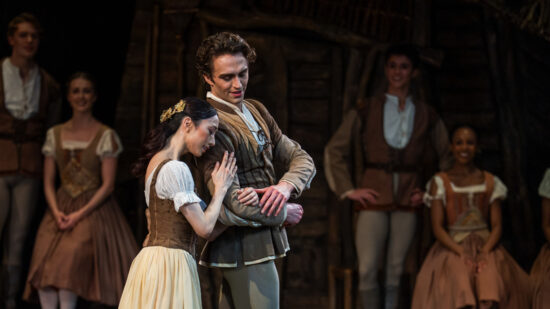
First created in 1985, Peter Wright’s production of Théophile Gautier’s scenario, inspired by Heinrich Heine’s De l’Allemagne and Victor Hugo’s poem Fantômes, with designs by John Macfarlane and set to Adolphe Adam’s score, continues to amaze with its sheer beauty and exquisite technical skill after well over 600 performances as it conjures up two distinctly vivid worlds as we move from the pastoral idyll of Act I to the supernatural moonlit graveyard of Act II and an unravelling tragedy.
Peasant girl Giselle (Akane Takada) has fallen in love with Count Albrecht (Matthew Ball) who is pretending to be a villager. To discourage her, her superstitious mother, Berthe (Kristen McNally), who prefers that Giselle marry the forester Hilarion (Valentino Zucchetti), tells the legend of the Wilis, ghosts of young women who dance to death any man who crosses their path between midnight and dawn. When Giselle discovers Albrecht’s real identity and that he has a fiancée, Bathilde (Olivia Crowley), the shock is too much for her and in her madness, she takes her own life.
Hilarion stands watch over Giselle’s grave which lies deep within the forest, but when it turns midnight, the Wilis appear and he initially flees in terror. When their queen, Myrtha (Annette Buvoli) arrives, she initiates Giselle’s spirit before the approach of Albrecht. Rendered powerless, both Hilarion and Albrecht now face a struggle to survive amidst the revengeful Wilis: will the spirit of Giselle be able to help either of them?
Macfarlane’s set is picturesque, capturing the isolated village scene with a lens-like view to a wilderness beyond, hinting at the reversal in Act II when the scene is darker and more dangerous with its uprooted and twisted trees with gnarled branches, and the safety of the village beyond only illuminated by David Finn’s recreation of lighting designer Jennifer Tipton’s burst of lightning flashes.
The Orchestra of the Royal Opera House, conducted by Vello Pahn, deliver a refined and romantic edge to Adam’s score, edited by Lars Payne, serving up a sensitive accompaniment to the charming on-stage performances, with the necessary brooding intensity heightening in the second half.
The quality of acting was of the highest standard, not only from the principals from the company as a whole. McNally’s mimetic skills are superb whilst Crowley delivers the necessary disdain. Zucchetti, glowering with anger, evokes sympathy as his frustration turns to sadness.
There is exceptional dancing with superb choreography from Marius Petipa, after Jean Coralli and Jules Perrot, from the stylish synchronised routines of Act I including the eye-catching Pas de six from Sae Maeda, Joonhyuk Jun, Viola Pantuso, Liam Boswell, Charlotte Tonkinson, and Daichi Ikarashi, through to Buvoli’s superbly performed and imperious Myrtha, wonderfully supported by Moyna (Leticia Dias) and Zulme (Mica Bradbury), with the spectral beauty of this ballet at its height during Act II’s Dance of the Wilis offering a moment of sheer technical brilliance from the Company’s corps de ballet.
Ball’s all-powerful Albrecht was matched by a performance of physical prowess with high jumps and rapid turns perfectly offset by expansive movement. His acting was equally strong, capturing the hedonistic arrogance before reflecting the guilt and shame that has led to such fatal consequences.
Takada simply excels in a role that she has made her own in the last ten years with impeccable technique and very much on pointe. Her routines with Ball were a delight and complemented by her own sensitive and insightful portrayal of a naïve young girl, in love for the first time, revealing her vulnerability and despair through her betrayal whilst offering forgiveness and redemption in consolation: bravo!
A superb production such as this relies on many parties that don’t easily fall into the narrative structure of a review so special mention to Christopher Carr and Samantha Raine for staging, Senior Répétiteur Samira Saidi, aided by Zhan Atymtayev and Stan Murphy, with Principal Coaching from Olga Evreinoff, Monica Mason, and Isabel McMeekan, and Benesh Chronology by Gregory Mislin, and Daniel Kraus.
Review Date: 2nd March 2026
Star Rating: FIVE