

‘a fascinating collaborative and creative effort delivering a beautifully choreographed fusion of dance, film, light, and music’
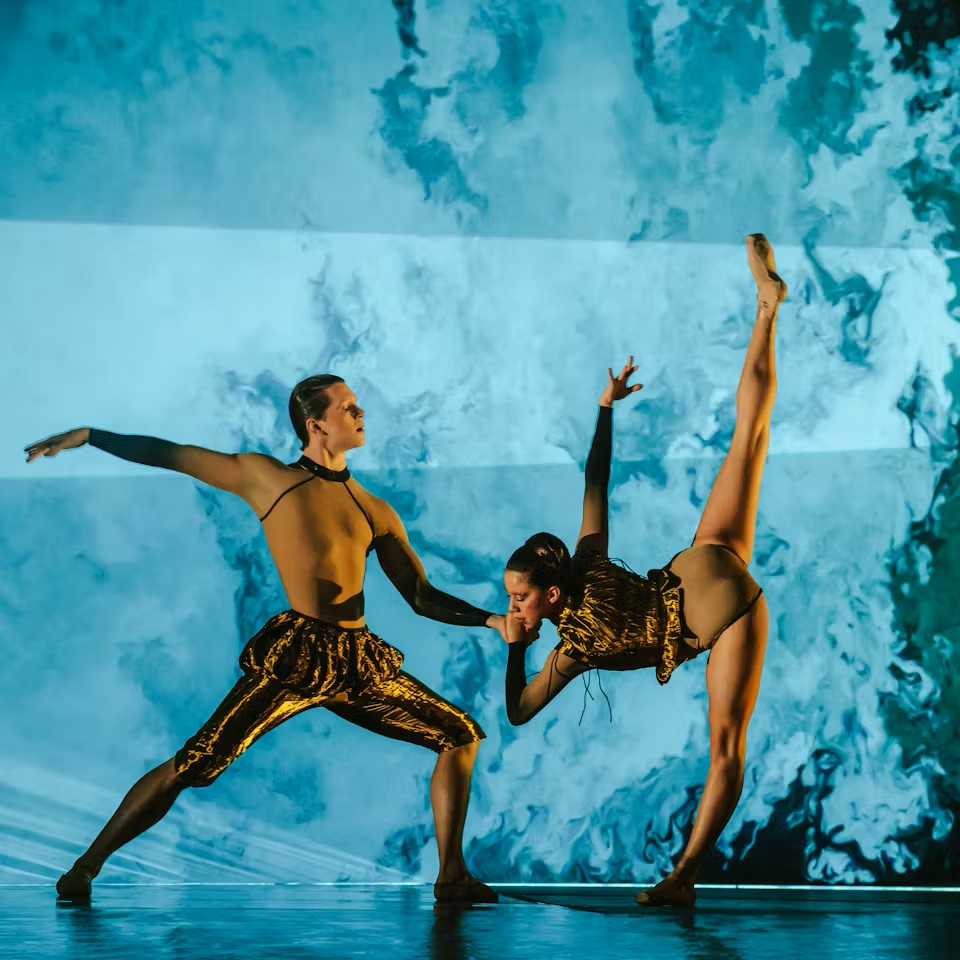
Wayne McGregor’s ballet triptych created in 2015 is inspired by the writings of Virginia Woolf and contains an original score by Max Richter, whose score for Hamnet has recently been nominated for an Oscar, – superbly performed by the Orchestra of the Royal Opera House conducted by Koen Kessels – with astounding lighting schemes from Lucy Carter and stunning set designs throughout, in this its third revival.
Woolf Works recreates the emotions, themes, and fluid style of three of Woolf’s novels beginning with ‘I Now, I Then’ inspired by Mrs Dalloway (1925); then ‘Becomings’ derived from Orlando (1928); concluding with ‘Tuesday’, which draws on The Waves (1931). The three pieces stand alone as distinctly as the works that inspire them although there is a chronology with underlying threads that seamlessly bring them together, most notably the central performance from Natalia Osipova as Virginia Woolf herself.
‘I Now, I Then’ opens with the only recording of Woolf’s voice from 1937 with a backdrop of Ravi Deepres’ grainy film of a bygone London accompanying Ciguë’s three slowly revolving open portals which present the novel’s shift between present and past and the worlds of two characters: Clarissa (Osipova), a middle-aged society hostess who dances in the safe embrace of her dull husband (Patricio Revé) whilst recalling her younger self (Sae Maeda), with a lesbian romance with friend Sally (Leticia Dias) sensitively remembered through a gentle kiss alongside the charm of one-time suitor Peter (William Bracewell). In contrast, shell-shocked Septimus (Marcelino Sambé) is haunted by nightmares he cannot escape from including the image of a dead friend (Marco Masciari) which affect his relationship with Rezia (Akane Takada). Unlike the novel, Clarissa and Septimus are brought together in the ballet to serve to echo for each other what might have been.
‘Becomings’ is in complete contrast with laser light show style effects designed to reflect the pace of the original novel in which a young nobleman lives three centuries without aging and with the mysterious change of gender during his travails represented by a 12-strong ensemble (Luca Acri, Harris Bell, Liam Boswell, Claire Calvert, Leticia Dias, Fumi Kaneko, Sae Maeda, Marco Masciari, Giacomo Rovero, Marcelino Sambé, Francisco Serrano, Akane Takada) replete in mock-Elizabethan androgynous outfits including ruffs, doublets and tutus created by Moritz Junge. With different pairings brought together to reflect different times, it was a frenzied affair across a minimalist set which presented a number of challenges for the dancers’ timing which has to respond to not only Chris Eker’s electronic sound and the acoustic music from the orchestra, but also the choreography of the lighting itself, which with its sci-fi influences, made it more difficult to warm to and connect with.
The final part, ‘Tuesday’, designed as well as choreographed by McGregor, is dominated by the poignant reading by Gillian Anderson of Woolf’s suicide note to her husband in 1941 against Ravi Deepres’ moving backdrop of black and white imagery of breaking waves from Cornwall, and sees the return of Osipova, as Woolf, with the pieces chronological childhood to grave action serving to reflect as her flashbacks as she drowns in what was an incredibly moving piece. Osipova, Bracewell, and Calvert stood out in a strong ensemble intended to represent the waves washing over the piece., with a haunting soprano solo from Marianna Hovanisyan.
This continues to be a fascinating collaborative and creative effort delivering a beautifully choreographed fusion of dance, film, light, and music, that responds to the underlying emotion and mood of each piece, as well as the individual characteristics of the performers themselves making each revival somewhat unique in nature, and which has gone some way to defining The Royal Ballet.
Review Date: 9th February 2026
Star Rating: 4