

‘the biggest winner of the evening was the music. . . Tchaikovsky’s beautifully simple yet luscious score’
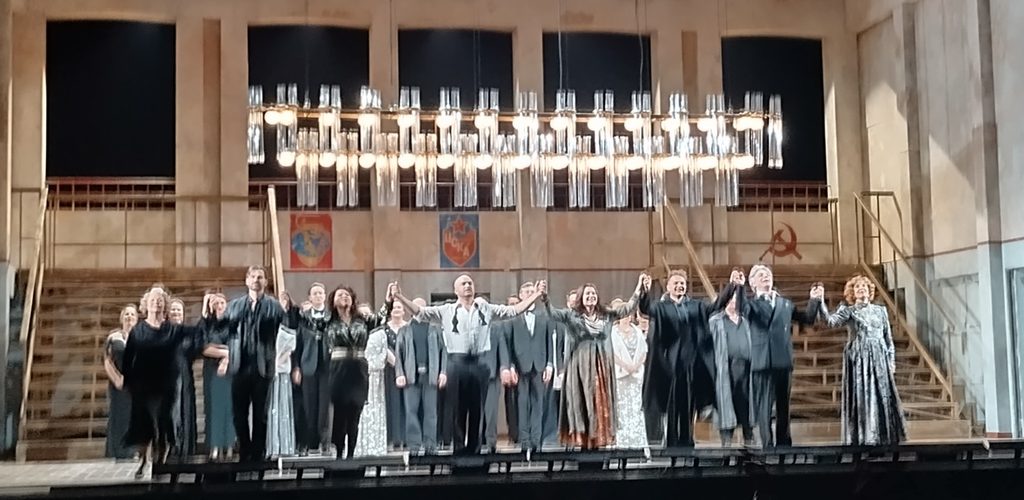
It’s been twenty-five years since Opera North’s last production of Tchaikovsky’s operatic take on Pushkin’s mock-epic verse novel upon which the opera’s libretto is based, and although, unwisely in my opinion, director Patrick Nolan has decided to bring the action forward some 150+ years, the spirited performance of the cast, chorus, and orchestra thankfully lessens that impact.
It is Autumn in the country, and the widowed Madame Larina (Hannah Mason) has two daughters: the romantic Tatyana (Verity Wingate) spends too much time reading novels, whilst the spirited Olga (Jingwen Cai) is being courted by their neighbour, the poet Lensky (Kamil Bień). When he visits with his friend, the aristocratic Eugene Onegin (John Brancy), Tatyana falls in love at first sight and writes him a passionate letter that she asks the family nursemaid Filipyevna (Claire Pascoe) to deliver. Onegin is less enamoured by the country girl however, offering only a friendship and a warning to control her emotions lest another man take advantage of her innocence.
Some months on, Onegin has accompanied Lensky to Tatyana’s name day celebration, but in boredom begins flirting with Olga. With his jealousy aroused and events spiralling out of control, Lensky challenges Onegin to a duel. With both full of remorse yet neither able to stop the duel, Onegin kills Lensky.
After several years travelling abroad, Onegin returns to St Petersburg where, attending a ball, Prince Gremin (Joshua Bloom) introduces his young wife: Tatyana. When Onegin expresses his love and asks her to run away with him, old emotions are stirred in Tatyana, but no longer the naïve country girl, what will the sophisticated socialite choose to do?
I welcome directorial interpretations as a means of keeping opera alive but it’s not always that simple when a piece is strongly connected with a period in time. Nolan’s decision to set the piece during Glasnost and Perestroika with the subsequent rise of the Oligarchs at first seems interesting but sadly its translation to stage left a lot to be desired and reflects unfairly on the usually impressive set designer Leslie Travers and costume designer Elizabeth Gadsby who are having to respond to a directorial whim.
Now set in a rundown school hall with two tiered, bench-style seating systems, the chorus admirably bring props on, only to return to take them off and give the seating an occasional spin. Why would Tatyana come here to write a deep meaningful love letter? Were the elaborately placed decorative panels supposed to reflect the wallpaper of her bedroom? Why would the oligarchs choose to install lighting designer Malcolm Rippeth’s sophisticated lighting array for their ball but not bother to repair and redecorate the hall itself? Rippeth does at least capture the movement of time from day to night to dawn in the background. Minor points perhaps but they jar with the action and the music, often getting in the way of the casts’ performances.
I must give credit to fight director Enric Ortuño who stages an impressive and very believable punch-up between Lensky and Onegin, with the subsequent duel scene cleverly and rather chillingly enacted as Russian roulette.
Wingate was excellent throughout, from the fresh-faced innocence of her country girl through to the haughtiness and poignancy of the self-possessed princess whose emotions are stirred. Displaying vocal flexibility throughout, the dramatic Letter Scene was particularly moving as she expressed the contrasting emotions of love and hate, despair and hope.
Brancy excelled both vocally and dramatically as he superbly brought to life the idiosyncrasies of a man who is neither villain nor hero, moving effortlessly from cold and calculating through to passion then despair with a strong and vibrant vocal throughout.
Bień wonderfully caught the youthful exuberance of the young poet perfectly before delivering a powerfully emotional rendition of ‘Kuda, Kuda’ reflecting the inner turmoil as he faces his impending mortality.
Cai delivered a bright performance as Olga with an impressive vocal that reflected the charm and grace of her character, further imbued with a real sense of playfulness.
Mason gave full voice to Madame Larina whilst Pascoe provided much needed depth to the old family nursemaid. Bloom’s appearance is brief but his aria in which he describes his happiness is moving and memorable.
A special mention too for Florian Panzieri’s delightful cameo with couplets as Monsieur Triquet; Paul Gibson’s Captain officiating at the party; and both Simon Grange as Zaretsky and Dean Robinson as Guillot, who provide assertive presences as Lensky and Onegin’s second’s respectively at the fatal duel.
Perhaps the biggest winner of the evening was the music with conductor Garry Walker delightfully and confidently leading the Orchestra of Opera North through Tchaikovsky’s beautifully simple yet luscious score, whilst the Chorus of Opera North under the direction of Anthony Kraus magnificently embellish the drama throughout with energy and enthusiasm combined with great choreography from Maxine Braham for some inspired 1980s dance routines.
Eugene Onegin is one of Opera North’s current touring productions, full details at https://www.operanorth.co.uk/whats-on
Reviewer: Mark Davoren
Review Date: 13th November 2026
Star Rating: FOUR