

‘In a week that has highlighted the worst in human behaviour, Verdi’s 1851 masterpiece reinforces. . . the ongoing power of opera to shine a light not only on the real villains but also on how they often get away with it’
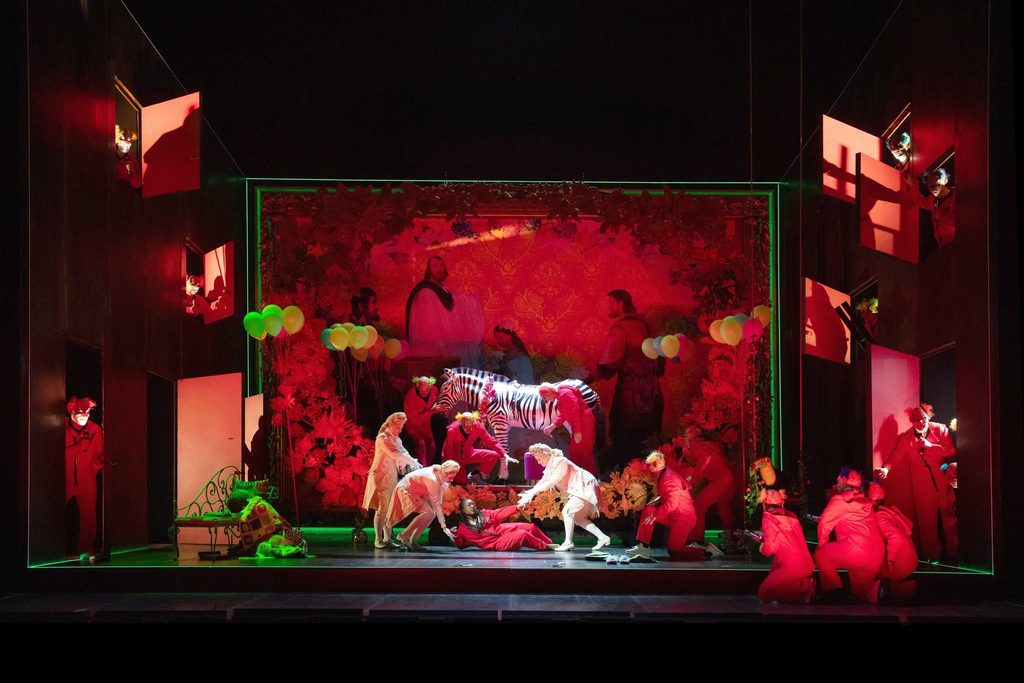
Having had the opportunity to watch a relaxed performance of the production at Opera North’s spiritual home in Leeds, it was good to see that Femi Elufowoju jr’s African-influenced interpretation of Giuseppe Verdi’s 1851 masterpiece travels well as well as receive some much-needed clarity on the zebra.
The Duke of Mantua (Leonardo Sánchez)) leads his courtiers in drinking and debauchery whilst his jester, Rigoletto (Blake Denson) mocks all those around. The arrival of Count Monterone (Sir Willard White) in a failed attempt to save his daughter results in a curse on the Duke and Rigoletto.
Rigoletto is tormented by the curse, and we discover he has a daughter, Gilda (Jasmine Habersham) whom he jealously guards, but the Duke has already spied and fallen for her – or has he? The courtiers have also tired of Rigoletto’s antics at court and under the steer of Borsa (Thomas Elwin) and Marullo (Themba Mvule), they trick him before carrying Gilda off to the palace.
Rigoletto arrives desperate to save his daughter from ruin and we are treated to a beautiful moment of reconciliation between them. When Monterone appears and retracts his curse on the Duke, Rigoletto assures him it will still come to fruition when he seeks revenge.
Rigoletto engages assassin Sparafucile (Calum Thorpe) with his sister, Maddalena (Alyone Abramova), used as a lure for the Duke so that Gilda may see the true behaviour of the man she believes she loves. Dramatic gestures abound as we hurtle towards a tragic end in the powerful and moving final act.
In a week that has highlighted the worst in human behaviour, Verdi’s 1851 masterpiece reinforces not only how little has changed, but the ongoing power of opera to shine a light not only on the real villains but also on how they often get away with it.
Rae Smith’s simple staging remains effective with an initial monochrome effect quickly giving way to an explosion of richness and colour in set, costume, and lighting as we entered the residence of the Duke, before a managed decline as we progressed through the acts cleverly echoing the main character’s fall. The set within a picture frame concept works well although I wonder whether the introduction of some kind of wing screen each side would be useful given the larger stage at the Lowry.
The orchestra initially seemed somewhat subdued before bursting into life under conductor Patrick Lange, proceeding to resonate strongly with the changing mood and emotions on stage with the wind writing particularly well played. There was some impressive choreography from Jackie Kibuka, with the abduction sequence in Act II and its subsequent retelling in Act III an absolute delight, with input from fight and intimacy director Alison de Burgh, although the freeze frame in the opening scene worked less well here.
Denson was impressive as the title character, using his obvious physical presence well throughout, with a skilled performance and strong vocal as his humanity comes to the fore as his world unravels around him.
Habersham started quietly and wavering, in much contrast to when I saw her perform the same role some four years ago, but her strong vocal eventually came to the fore, none more so than in the tender and emotional ‘Piangi, fanciulla’ duet with Denson.
Sánchez performed strongly with good characterisation and a resounding ‘La donna è mobile’ in Act III, whilst White was superb demonstrating both power and presence in his brief appearances. Thorpe was suitably ruthless with a strong vocal, and his Act IV aria with Abramova and Habersham combined impressively with Howard Hudson’s lighting array and the power of the orchestra to deliver some real thunder.
Elwin – who had impressed as the Duke in the relaxed performance at Leeds Grand Theatre – and Mvula both caught the guile and cunning of their respective characters, whilst further strong support came from other cast members including Molly Barker-Knowles, Ross McInroy, Helen Évora, James Davies, and Laura Kelly.
And finally, of course the zebra: it was suggested to me during the interval that in Nigeria, the zebra is a symbol of serenity and hence in the production it is intended to represent a safe space for Gilda. Well, I couldn’t find any reference online to prove the point, but I can certainly appreciate director Femi Elufowoju jr’s subtle intention as Gilda’s own world is shattered.
Rigoletto is one of Opera North’s current touring productions, full details at https://www.operanorth.co.uk/whats-on
Reviewer: Mark Davoren
Review Date: 13th November 2026
Star Rating: FOUR