

‘Costa-Jackson. . . was exceptional, with mesmerising movement and a velvety vocal that smoulders with emotion, frustration, and rage, she embodied all that Carmen is’
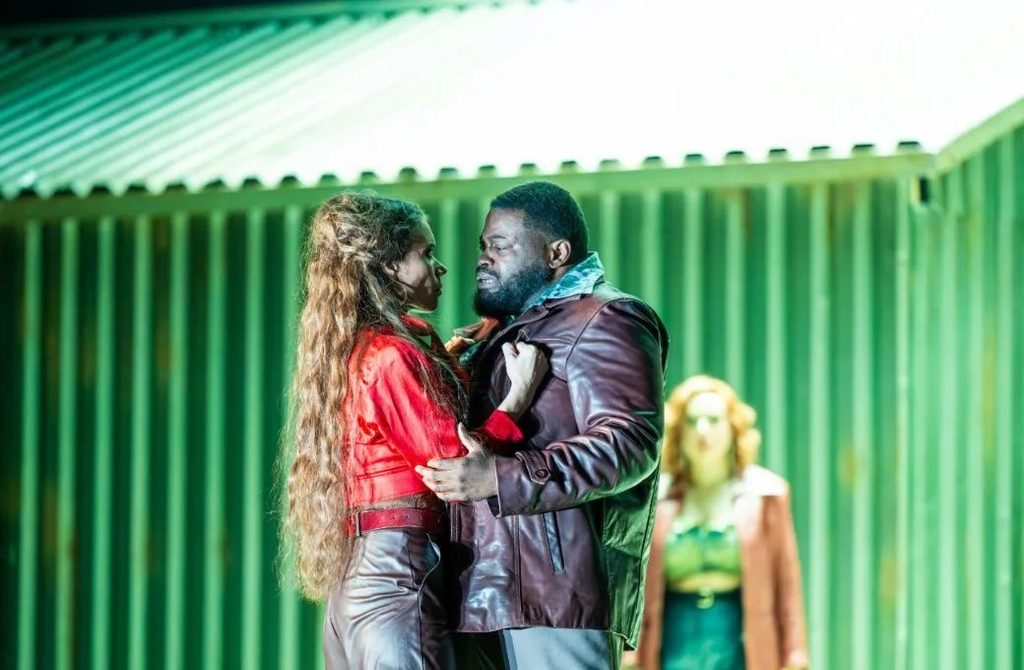
Revival Director Dan Dooner goes some way to correcting some of the challenges with this revival of Damiano Michieletto’s interpretation which whisks us away from 19th-century Seville to a small town in a remote and rural Spain in the 1970s, although I still cannot fathom why he has retained the character of Don José’s widowed mother on the stage when she is only ever referred to in the libretto.
In an unnamed town, naïve policeman Don José (Russell Thomas) falls head over heads in love with Carmen (Ginger Costa-Jackson), a seductive and free-spirited girl working at the local factory. Infatuated, Don José abandons his childhood sweetheart, Micaëla (Adriana Gonzalez) and neglects his military duties only to lose the fickle Carmen to the glamorous rodeo rider, Escamillo (Alexander Vinogradov).
Although there was good use of darkness, light, and shadow, Alessandro Carletti’s lighting array continues to resemble something you would find in a modern office interior rather than the inescapable sunlight and heat which might provoke emotions to erupt at any minute.
Paolo Fantin’s stage design is simple, and I quite liked the use of a cutaway building within each act which in combination with a part revolving stage allowed us to explore internal and external environments as well as scenes within scenes, keeping the action alive on stage allied with some strong choreography.
It was particularly pleasing to see Dooner moving away from the sitcom caricature of previous productions, instead hinting at seventies sexploitation which resonates so strongly with the underlying themes of the original, in a combination of seediness and sleaze meets sassy, sexy, and sultry, with resplendent costumes from Carla Teti to match.
Conductor Sesto Quatrini impressed from the off with a very quick start for the Orchestra of the Royal Opera House bringing an immediate energy and capturing the emotion of the piece that was maintained throughout in a lively performance.
The Royal Opera Chorus performed strongly under the direction of William Spaulding, with the necessary underlying edge simmering throughout. The introduction of the Youth Opera Company was cleverly and sensitively handled so as not to become a distraction and importantly gave these children an experience they will never forget and the signpost to a future career.
Another celebrated success was the 25th anniversary of the Jette Parker Artist programme, a two-year professional residency for curious artists of exceptional talent who want to intensify the development of their craft and take their first steps on the international stage. With five performing strongly in key roles as part of tonight’s production – Seohyun Go and Ellen Pearson as Carmen’s friends, Frasquita and Mercédes; Giorgi Guliashvili and Emyr Lloyd Jones as smugglers, Dancaïro and Remendado; and Sam Hird as Moralès, an army corporal – there were another four in off-stage roles.
In supporting roles, Gonzales performed well despite the enforced frumpy constraints on her girl-next-door Micaëla complete with thick schoolgirl glasses, whilst Vinogradov, caught the exuberance of Escamillo in a controlled performance befitting of his matador status. Barnaby Rea as Zuniga, Don José’s senior officer, captured the balance between military officiousness and bumbling perfectly.
Thomas demonstrated great vocal power and stamina, but I would have liked to see a stronger chemistry/connection towards Carmen: this is after all, the woman who he literally gives everything up for.
The night though belonged to Costa-Jackson whose performance was exceptional, with mesmerising movement and a velvety vocal that smoulders with emotion, frustration, and rage, she embodied all that Carmen is: a star is born and a bright future beckons.
Reviewer: Mark Davoren
Review Date: 10th May 2026
Rating: FOUR