

‘Cale delivers an impressive lament. . . capturing the despair and despondency of the situation’
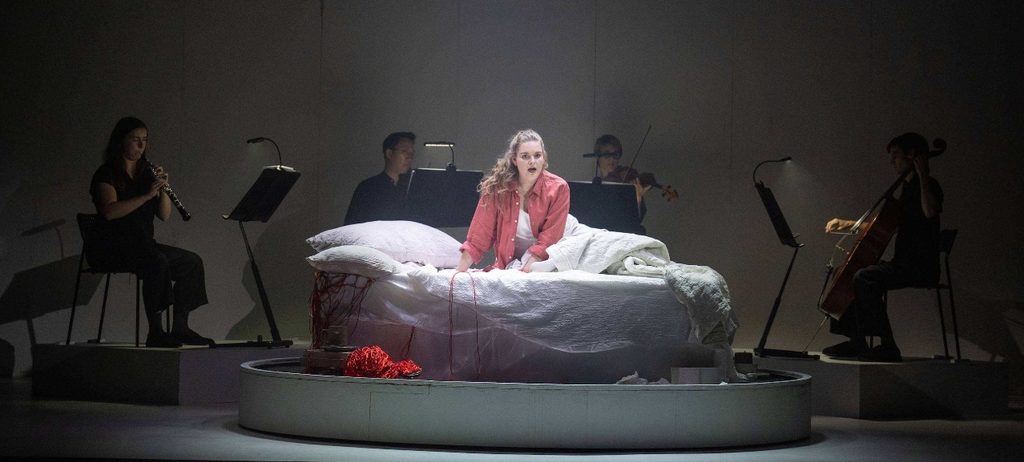
Langer sets Glynn Maxwell’s poem, Ariadne to Theseus, into a twenty-minute one-act powerhouse performance for soprano in an intimate retelling of the myth of Ariadne and performed as the first half of a double-bill with Purcell’s Dido & Aeneas, which is reviewed separately.
Ariadne (Jessica Cale) wakes on the shore and finds Theseus (Kieron-Connor Valentine) gone. She helped him escape Crete, leaving her home, her family, and the life she knew behind. Now she has been abandoned.
Director Anna Morrissey has chosen not to leave Ariadne on stage alone as such; with Theseus unravelling himself from her and then circling and rotating the bed she is lying in, it is clear that this is her mind playing over and over the events that took place.
Although we often say less is more, Alex Berry’s set design seemed overly simplistic although the red thread as a metaphor worked on so many levels – love; death; passion – rather than just as the device that Ariadne had given to Theseus to enable him to overcome the Minotaur. Stitching it into her breast at the end was equally powerful in reflecting her hope that he might find his way back to her.
The addition of the quartet – Violin (Gary Ngan); Viola (Hannah Gardiner); Cello (James Heathcote); Oboe (Hannah Condliffe) – on stage served to echo her struggles to decipher what has happened, although musically it was perhaps a little too dissonant at times for my liking. I did enjoy the occasional underlying hints of Klezmer – intended or otherwise – that reinforced the sense of wandering. In the absence of a conductor, preparation from Claudia Fuller ensured there was a good connection between them and Cale throughout.
Cale delivers an impressive lament, unhampered by her positioning on the bed from which she cannot escape, and vocally capturing the despair and despondency of the situation she finds herself in.
There is perhaps too much repetition musically for such a short piece which is over almost as soon as it has begun, so much so that it felt something was missing – not just Theseus.
Reviewer: Mark Davoren
Review Date: 24th October 2026
Star Rating: THREE