

‘director Louisa Proske. . . doesn’t pull her punches with this somewhat bloodied and brutal season-opening new production’
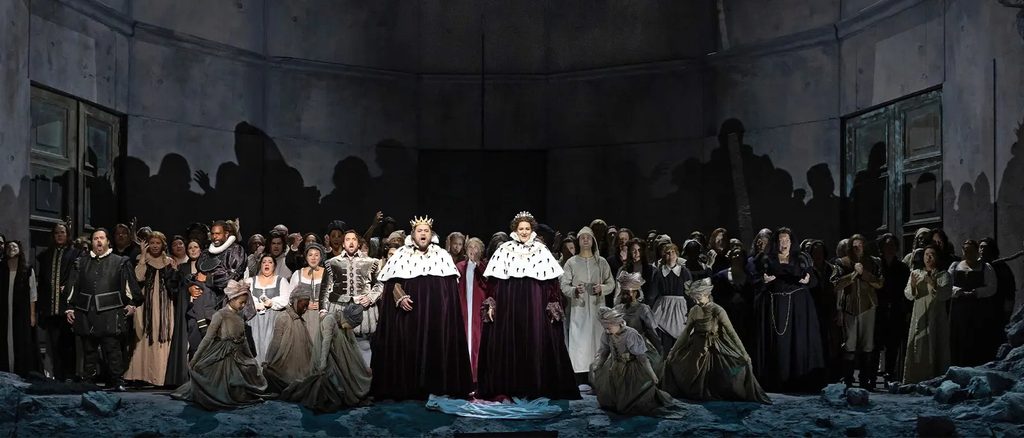
Verdi famously noted of this opera that there are only three roles, and there can only be three, and director Louisa Proske, on her Metropolitan debut, very much takes him at his word and doesn’t pull her punches with this somewhat bloodied and brutal season-opening new production.
Macbeth (Quinn Kelsey), a loyal general receives a prophecy from a chorus of weird sisters/witches that he will be crowned King of Scotland, but they also tell his aide, Banquo (Ryan Speedo Green), that his descendants will be the future heirs to the throne.
Macbeth plots with his wife, Lady Macbeth (Lise Davidsen), to take the crown and murder follows murder, as night follows day. But as the guilt begins to unravel for the Macbeths, exiled MacDuff (Freddie de Tommaso) and Malcolm (Jonathan Burton) lead a force to Scotland to seek their revenge and everything finally comes to a head.
Proske’s production makes very strong parallels to modern-day conflicts, the rise of autocratic regimes, and the tyrannical oppression of people, with The Met opting to precede the performance with a rousing rendition of the Ukrainian national anthem. A core group of sisters/witches are a continual presence on the stage reflecting internal demons and/or tormenting phantoms, whichever way you want to view it.
This is all eloquently echoed in Jon Bausor’s wasteland set design complete with revolving concrete silo, reflecting a post-apocalyptic world, that allows us to segue between scenes. Lighting designer Adam Silverman’s candle-lit darkness reflects the sombre action unfolding on stage albeit the over-riding gloomy theme becomes a little monotonous as the night goes on, although occasional splashes of blood ironically inject some life into it.
Montana Levi Blanco’s costume design alludes to hardship and the struggles of the people although those in seniority were dressed in Elizabethan-style ruffs which historically is a few hundred years after the piece is set; I would have preferred to have seen them reflect more with the conflict in Ukraine as the Cossack-inspired dance routine (George Goderdzishvili, Data Darakhvelidze, Luka Kikacheishvili) at the banquet did. Indeed there is some wonderful choreography on offer throughout from Jorrell Lawyer-Jefferson and some excellent fight scenes which benefit from the input of action director Ran Arthur Braun.
The cast perform strongly with notable support in minor roles from Burton, Marcy Stonikas, Christopher Job, Jeongcheol Cha, and Bradley Garvin.
Kelsey delivered a passionate portrayal of the tragic king, with a commanding stage presence and a highly refined vocal that perfectly captured his character’s increasing turmoil and hesitancy before a staccato-like descent into madness.
Davidsen was in peak vocal form as one has come to expect from her but her statuesque presence and powerful vocal, whilst both perfectly suited for Wagner, belie the necessary acting quality to embellish the ruthless ambition of her character, albeit she managed to soften her tone for the deeply haunting sleepwalking scene.
Speedo Green was somewhat subdued as an emotional Banquo, a secondary role with little to get his teeth into, although he brought warmth to his warnings about the witches’ prophecies. In contrast, De Tommaso as Macduff also has only one aria to get stuck into, but his heartbreaking rendition captured the necessary anguish and intensity, providing a standout moment of the production.
The standout role undoubtedly was that of the chorus, under the capable direction of Tilman Michael, whose uniform demonic singing as the coven of witches was particularly chilling, whilst as refugees, their sorrowful rendition of the famous chorus ‘Patria oppressa’ was especially emotional as it brought to mind the many innocents suffering as a consequence of conflict.
Maestro Yannick Nézet-Séguin brought the colours and drama of a darkly atmospheric score together as one, leading the Metropolitan Orchestra in an energetic, passionate, and engaging performance.
The production is one of a series of collaborations between The Metropolitan Opera and the Royal Ballet & Opera, London.
This performance was dedicated to the memory of Martina Arroyo, an American operatic soprano who was part of the first generation of black opera singers to achieve wide success from the 1960s onwards.
Reviewer: Mark Davoren
Review Date: 20th October 2026
Star Rating: FOUR