

‘the rich, existential text. . . is now better than ever at engaging with its audience’
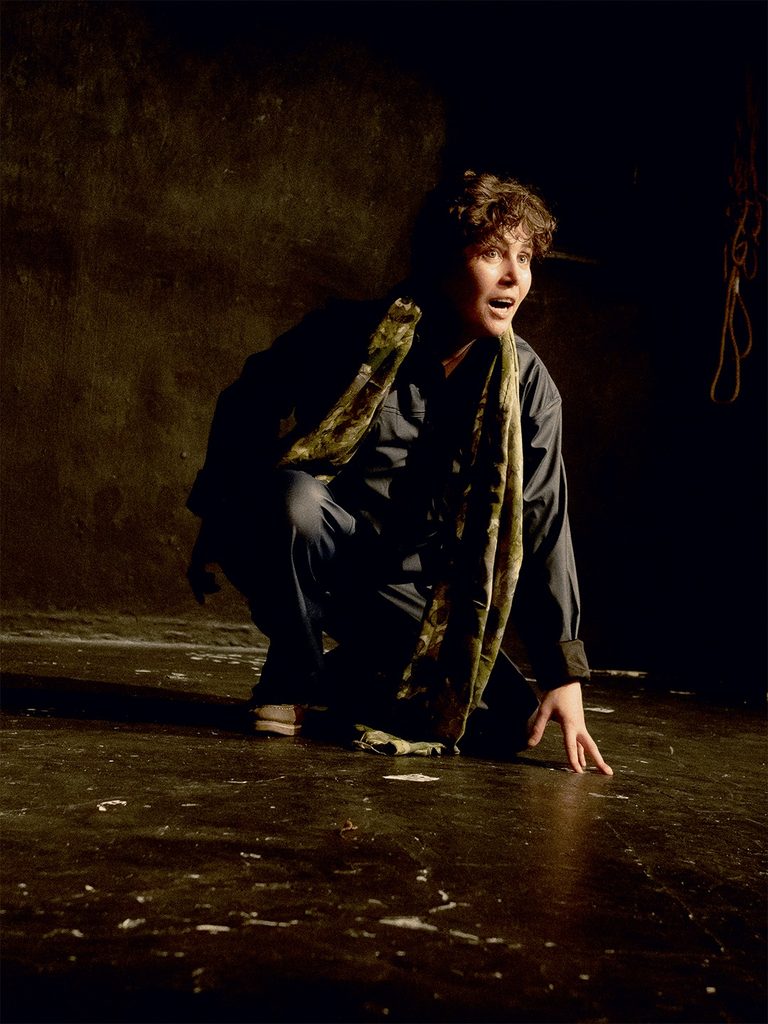
Understudy No 5, Hadrian Conyngham’s lyrical one-man play featuring sidelined Shakespearean characters and a theatre janitor being possessed by them is back after a ‘work in progress’ run that outmatched most polished productions of its kind.
Our protagonist, the Janitor, is cleaning up the stage when he seemingly finds himself possessed by characters associated with various misplaced props: a gravedigger from Hamlet who rails against the out-of-touch medieval Danish upper class with many morbid (and slightly threatening) allusions to graves and holes; Benvolio, Romeo’s inconsequential cousin who lets us into his resentful heart and ugly schemes; Cobweb, a normally speechless character who is tortured by the linguistical prison of iambic pentameter; and a time travelling stage musician, whose memory, which ‘requires imagination’, has begun to fail him after so many performances of the same basic stories, night after night, through passing lives and centuries. In the middle of it all, the Janitor, who doesn’t express himself much – except, perhaps through all these ghosts as they lament the various ways they have been trapped by narrative, language or societal norms: ‘Even the Janitor has something else he’d like to do.’
It’s a pleasure to see artists at work as Conyngham, along with director Warren Rusher and movement director Dan Hardwell, have clearly reworked the rich, existential text into a livelier piece that is now better than ever at engaging with its audience. In fact, from the first five minutes, the most significant change came from audience members themselves: they seemed more ready to laugh, react and answer Conyngham’s questions, not because the jokes were funnier or the questions more interesting, but because Conyngham, who has now sunk into these characters and his own words enough to have fun with them, succeeds in inviting us into a world that might otherwise be alienating, what with its unapologetically dense language and abundant Shakespeare references.
The piece also feels significantly more personal. As the Janitor’s stake in the story has become clearer, so have the ghosts’ woes become more viscerally identifiable. To watch Cobweb madly fight against the language that was imposed upon her now truly feels like witnessing something unbearable. And the gravedigger’s obsession with holes and those buried in them is coloured with the pain felt throughout the rest of the play: for some, the rigid imposition of roles and the forms they must take only makes the stage at the centre of which they are free to happily repeat their lines again and again; for others, to obey the narrative can feel less like occupying the stage, than being buried under it.
Reviewer: Natalie Morris
Review Date: 16th October 2026
Star Rating: FIVE