

‘Dunbar successfully overcomes the perception that Beckett’s writing. . . is complex, with this production demonstrating that. . . it is a theatrical experience that credits its audience with being intelligent’
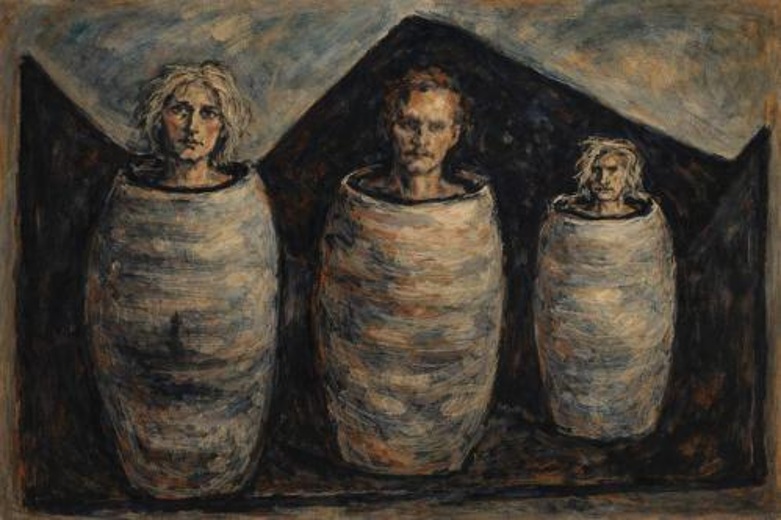
As part of the Beckett: Lieben 2026 Biennale, Unreal Cities present a double bill of Samuel Beckett’s Play and Come and Go.
Directed by Adrian Dunbar, the two plays highlight the continuing relevance of Beckett’s work in capturing the consistency of human emotion and behaviour over time, or as the great man may have put it: plus ça change, plus c’est la même chose.
We open with Play as we observe three heads poking out from funeral urns – Man (Frank McCusker), W1 (Clara Simpson), and W2 (Orla Charlton) – in some kind ofpurgatory as they recall the events of an affair that connects them although it is unclear whether they are aware of each other’s presence, as they appear to seamlessly interact through their hurried recollections whilst occasionally talking over each other, before the piece purposefully repeats.
Beckett asks for an accelerated delivery which is the challenge for any director – although I’ve always thought of purgatory as some kind of hell that we would all be rushing to get through – and I found the purpose and pacing tonight from the cast spot on. We heard enough to build a picture of events whilst, like them, not really being able to form a clear view of the whole which resonated perfectly with this kind of situation – an affair – when all of the involved parties will have a different view, and no one ever really listens.
The added demand of this piece lies off-stage with the accompanying lighting changes needing to continually switch between each rapidly talking head. Dunbar’s production was faithful to Beckett’s intention for a searching spotlight to move between the heads, with much credit to Michael Cummins whose intimate knowledge of the text ensured this was so much more than a lighting effect.
After a short interval, the second play Come and Go presents three elderly women named Flo, Vi, and Ru (Anna Nygh; Charlton; Simpson) wearing drab, full-length coats and hats of dullish colour, sat on a bench. One by one, a woman exits and returns, but whilst away, the remaining pair whisper an apparently, chilling, unheard secret about the absent woman’s impending or rumoured terminal illness.
Beckett referred to this play as a dramaticule, as it telescopes three entire lives into minutes with measured silences – well presented by the cast – powerfully expressing the deep and profound connection between the women across a lifetime of challenges and disappointments, with the closing sequence as they link arms particularly moving, and the cast’s all round strong performances reinforcing this is as one of Beckett’s most ‘perfect’ plays.
Beckett himself proposed the pairing of these two plays to director Walter D. Asmus in Germany, and they presented the double bill together at the Schiller Theater in West Berlin in 1977, with Beckett directing Play and Asmus directing Come and Go.
Here, Dunbar successfully overcomes the perception that Beckett’s writing – like the man – is complex, with this production demonstrating that in reality it is a theatrical experience that credits its audience with being intelligent and allows them to interpret the work and the words accordingly.
Beckett: Lieben 2026 Biennale is an international festival celebrating the works of Dublin-born writer Samuel Beckett, in Liverpool from 17th to 20th September. Curated by Adrian Dunbar and Nick Roth of Unreal Cities in collaboration with the Institute of Irish Studies at the University of Liverpool, Culture Ireland, and the Keough-Naughton Institute for Irish Studies at the University of Notre Dame, the full programme can be found here https://www.liverpool.ac.uk/humanities-and-social-sciences/research/beckett/
Play and Come and Go perform as a double bill at Liverpool Playhouse, further details and booking https://everymanplayhouse.com/event/beckett-lieben-2026-play-and-come-and-go/
Review Date: 17th September 2026
Star Rating: FIVE